
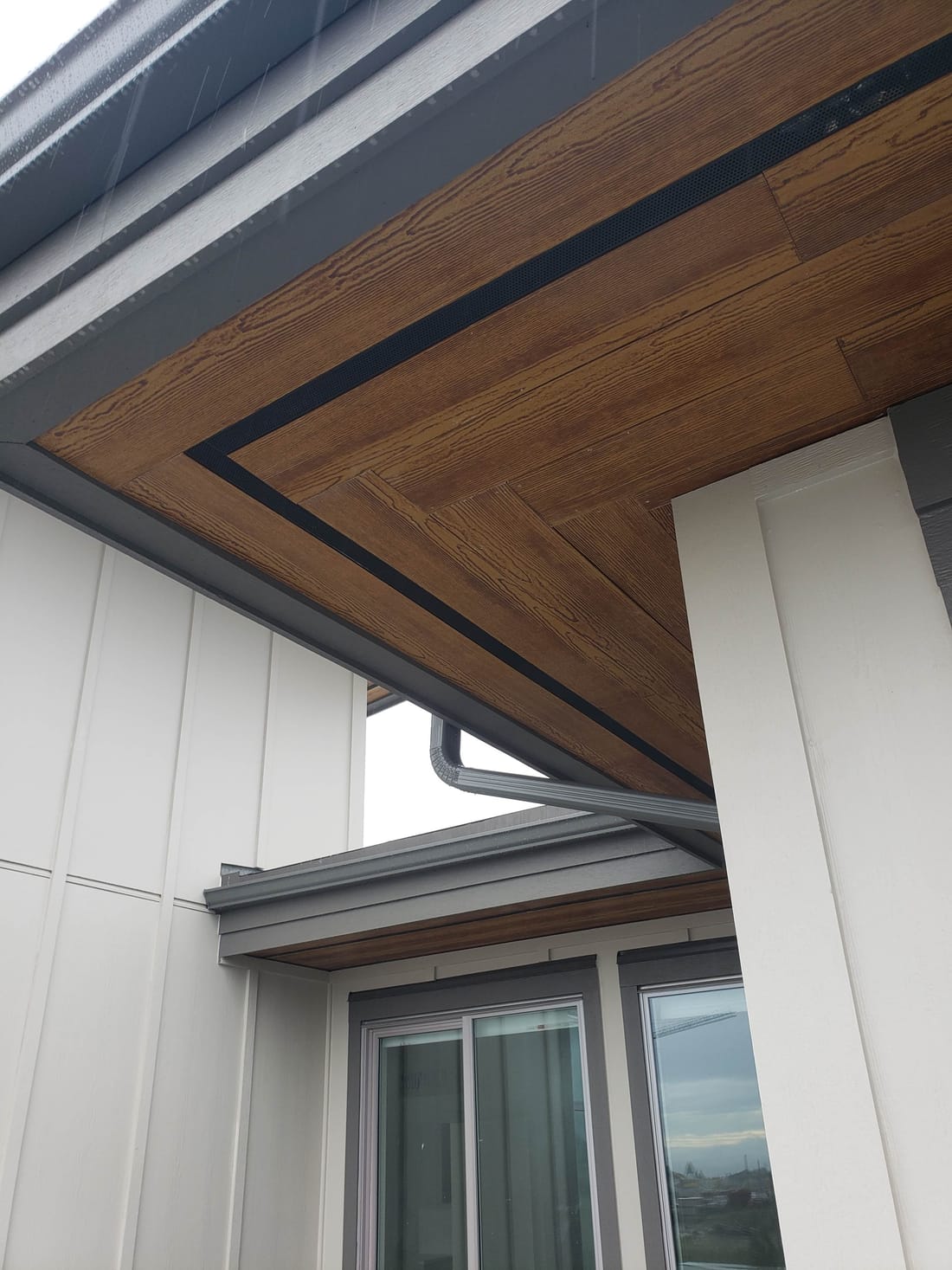
Soffit & Fascia in Vancouver
Soffit and fascia across Vancouver, from century-old character homes with original wood eaves to Specials and laneway builds where the roofline was never detailed for the rain it takes.
Built for how Vancouver weathers.
Vancouver roofline problems split by era. On pre-war houses in Kitsilano, Dunbar and West Point Grey, original wood soffit was frequently built solid with no venting, and ninety years of repainting has closed whatever vents were later cut in. Those attics have no reliable intake air, which is why we find condensation and mould on sheathing in character homes that have never had a roof leak. On Vancouver Specials, the flat-ish rooflines and long fascia runs mean a single overflowing gutter soaks a lot of board before anyone notices. We replace with vented aluminum sized to the attic it actually serves, or work in wood where the character of the house justifies the maintenance.
Vancouver's housing stock runs from pre-war craftsman homes in Kitsilano and Dunbar to thousands of Vancouver Specials with original stucco, plus laneway houses and infill on tight lots.
Soffit does two jobs: it closes off the underside of your eaves against weather and pests, and it feeds the attic ventilation your roof needs to avoid condensation and premature failure. We install vented aluminum soffit systems sized to your attic's airflow requirements.
- Vented and solid aluminum soffit
- Attic ventilation sizing
- Colour matching to fascia and siding
- Pest and bird blocking
- Repair of sagging or wind-damaged sections
- Standalone or bundled with siding work
How we run soffit & fascia in Vancouver.
Roofline inspection
We check panel condition, venting area and any signs of pests or moisture in the eaves.
Scope and colour match
Written quote with venting calculations and colour options matched to your trim.
Install
Old material removed, framing checked, new soffit installed with clean edges and secure fastening.
Soffit & Fascia in Vancouver: what owners should know.
The Roofline Is Usually Older Than Your Siding Problem
Soffit and fascia get overlooked because they sit at the top of the wall where nobody inspects them. In Vancouver's older housing they are frequently the part of the exterior causing the most damage while attracting the least attention.
Soffit is the underside of the eave. Fascia is the vertical board at the roof edge that your gutters hang from. Together they close the roof edge, carry the drainage system, and provide the intake air your attic depends on. When any part fails, the consequences move inward: wet insulation, condensation on the roof sheathing, mould, and shingles aging from below.
Two Vancouver Patterns
Character homes with solid soffit. Pre-war houses through Kitsilano, Dunbar, West Point Grey, Kerrisdale and Mount Pleasant were commonly built with solid wood soffit and no venting at all. Some had vents cut in later, usually too few, and ninety years of repainting has closed most of those. The result is an attic with no reliable intake air.
We find condensation and mould on roof sheathing in character homes that have never had a single roof leak, and owners are consistently surprised because they have been looking for a hole in the roof. The water came from inside the house, rose into the attic and had nowhere to go.
Specials with long fascia runs. Vancouver Specials have shallow roof pitches and long uninterrupted fascia runs. A single gutter overflowing at one point sends water down the back of the fascia across a long stretch, and because the pitch is shallow there is less overhang shedding water clear of the wall. By the time the gutter starts sagging, the board behind it has usually been wet for years and the damage has often reached the sheathing edge and rafter tails.
Ventilation Is the Part Owners Miss
Attic ventilation is a two-part system. Soffit vents bring cool dry air in at the eaves, roof or ridge vents exhaust warm moist air at the top, and the pressure difference drives continuous airflow that carries moisture out of the assembly. Remove either half and the system stops working.
The most common way it gets broken is insulation. When attic insulation is topped up and pushed out toward the eaves, it frequently buries the soffit vents entirely. The attic is now better insulated and considerably worse ventilated, and moisture problems begin the following winter. Baffles at the eaves keep that air path open and installing them is a normal part of doing this work properly.
The second way is paint. Perforated soffit repainted enough times has functionally sealed vents that still look correct from the ground.
When we quote soffit in Vancouver we calculate the intake area the attic actually requires rather than replicating what was there, because replacing an unvented soffit with a new unvented soffit fixes the appearance and none of the physics.
Materials, Including the Heritage Question
Vented aluminum is the practical default: it does not rot, needs no refinishing, holds its finish through Vancouver winters, and comes in profiles and colours that suit most houses. Sized correctly for intake area and installed with eave baffles, it solves both the durability and the ventilation problem at once.
Wood remains the right answer on some character homes. On a heritage-listed property, or a house where the eave detailing is a defining part of its architecture, aluminum can read wrong regardless of colour match. We work in wood on those projects with proper priming on all faces and a finish schedule, and we are direct about the maintenance commitment that carries in this climate.
The compromise that usually satisfies both concerns is wood-detailed fascia and trim with vented aluminum soffit tucked underneath where it is far less visible from the street.
Custom-bent fascia is formed on site to match your roof edge, which matters on older houses where nothing is quite square and stock lengths do not follow the existing line.
Structural Repair Comes First
Where rafter tails or the sheathing edge have rotted, we repair the structure before new material goes on. Covering rot is not a repair, and on a roofline the consequence of covering it is that the new gutters lose their fixing within a few years.
On older Vancouver houses this is common enough that we assume some structural repair is likely and inspect for it during quoting rather than discovering it on day one.
This Work Stands Alone
Soffit, fascia and gutters form a self-contained system at the roofline. You do not need to reclad your house to renew them, and we do not bundle work you do not need.
If the walls below are also near the end of their life we will say so and price both, because doing roofline work and then recladding a year later means paying twice for the same access and staging on a Vancouver lot where staging is expensive. But if the siding has years left, replacing the roofline on its own is the right call and that is what we will quote.
The reverse holds too: when we reclad a Vancouver house we almost always recommend renewing the roofline at the same time, because the scaffolding is up, access on a narrow lot is the hard part, and a new wall under a failing eave is a short-lived improvement.
Worth Booking a Look
Staining or sagging along the underside of the eaves. Gaps where birds, wasps or rodents have entered the roof edge. Peeling fascia paint, especially where gutters overflow. Gutters pulling away or holding standing water. Daylight visible from inside the attic where it should not be. Frost, condensation or musty air in the attic in winter.
Call (672) 771-6868. We will inspect the full roofline and the attic intake path, not just the section you asked about, and give you a written quote at no charge.
Soffit & Fascia questions in Vancouver.
Soffit & Fascia quotes in Vancouver.
Tell us about your Vancouver project and we will respond within one business day to book a free site visit, then follow up with a clear, line-itemed quote.