
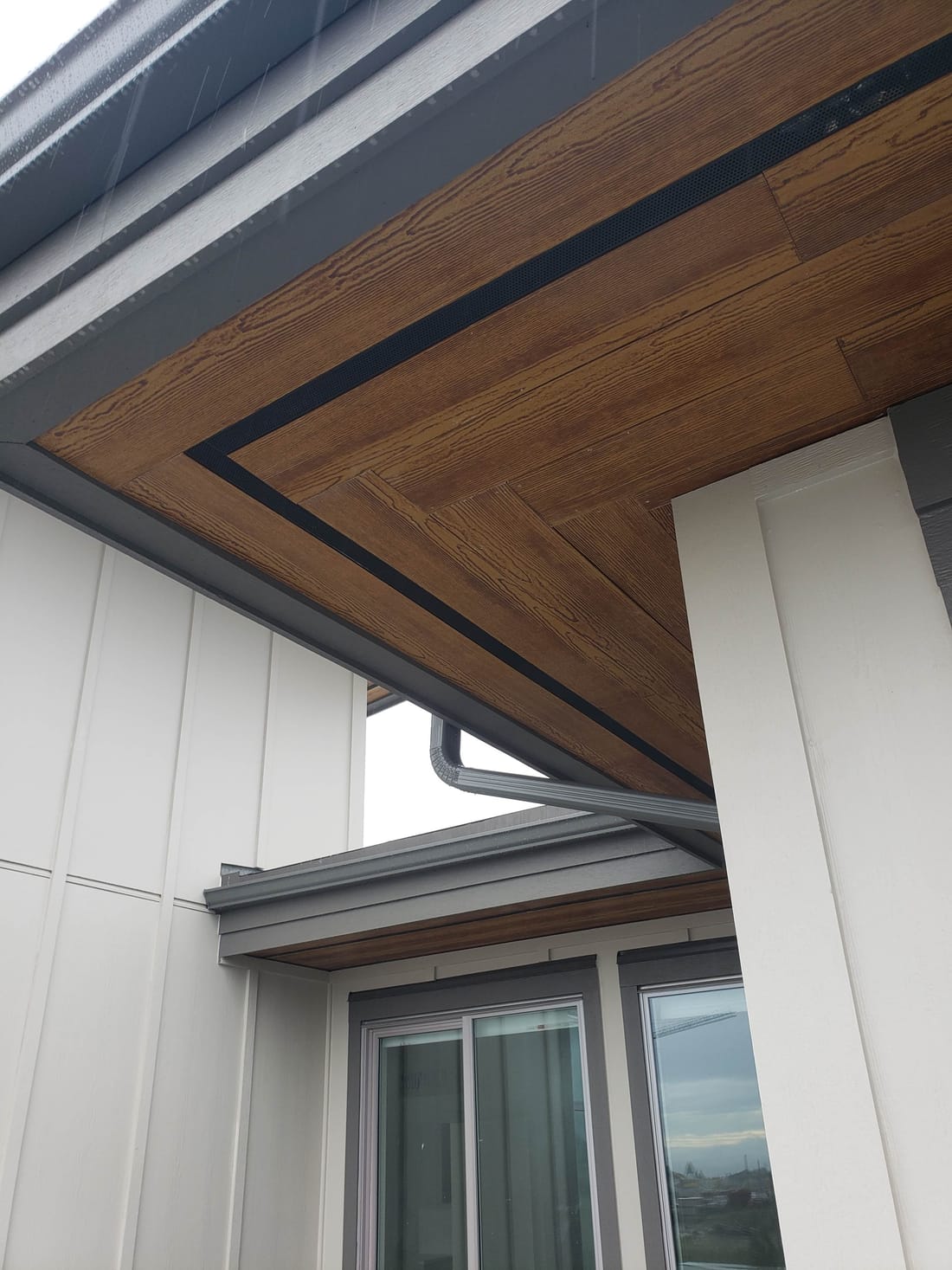
Soffit & Fascia in North Vancouver
Soffit and fascia for North Vancouver, where steep roofs, heavy rain and constant needle litter put more water and debris through the roofline than anywhere else in the region.
Built for how North Vancouver weathers.
North Shore rooflines take a beating. Steep pitches dump water past the eaves at volume, conifer needles pack gutters solid by November, and once a gutter overflows the fascia behind it stays wet all winter. Under Lynn Valley and Blueridge tree canopy we also see soffit vents blocked with moss and debris, which strangles attic intake air in exactly the climate where attics most need to dry. Our roofline work here pairs generously vented soffit with fascia heavy enough to carry gutters through an atmospheric river, and we check the attic intake path rather than just replacing what was there.
North Vancouver homes in Lynn Valley, Deep Cove and along the mountain slopes sit on forested lots where cedar siding has been the default cladding for decades.
Soffit does two jobs: it closes off the underside of your eaves against weather and pests, and it feeds the attic ventilation your roof needs to avoid condensation and premature failure. We install vented aluminum soffit systems sized to your attic's airflow requirements.
- Vented and solid aluminum soffit
- Attic ventilation sizing
- Colour matching to fascia and siding
- Pest and bird blocking
- Repair of sagging or wind-damaged sections
- Standalone or bundled with siding work
How we run soffit & fascia in North Vancouver.
Roofline inspection
We check panel condition, venting area and any signs of pests or moisture in the eaves.
Scope and colour match
Written quote with venting calculations and colour options matched to your trim.
Install
Old material removed, framing checked, new soffit installed with clean edges and secure fastening.
Soffit & Fascia in North Vancouver: what owners should know.
The Hardest Roofline Conditions in Metro Vancouver
North Vancouver rooflines handle more water and more debris than anywhere else we work, and the two problems compound each other.
Steep North Shore roof pitches move water off the roof surface fast and dump it past the eaves at volume. At the same time, mature conifer canopy across Lynn Valley, Blueridge, Deep Cove and Pemberton Heights drops needles continuously, and needles are the worst possible gutter debris because they knit into a dense mat rather than washing through. By late autumn many North Shore gutters are effectively solid.
A blocked gutter under a steep roof in an atmospheric river does not overflow gently. It sheets water down the back of the fascia and over the soffit, which is precisely the path that causes the most damage in the least visible place.
What We Find on North Shore Rooflines
Fascia rotted from behind. The signature North Vancouver roofline failure. Years of overflow keep the back face of the fascia permanently wet through the winter. The board softens, gutter fasteners lose their bite, and the gutter begins to sag and pull away. By the time it is visible from the ground the rot has often reached the sheathing edge and rafter tails.
Soffit vents blocked with moss and debris. Under heavy canopy, perforated soffit clogs with needle litter and moss establishes in the perforations themselves. The vents are physically present and functionally closed, which strangles attic intake air in exactly the climate where attics most need to dry.
Rot at the soffit-to-wall junction. Where overflow has been running for years, damage spreads inward from the eave along the wall top.
Wind damage on exposed elevations. Storm gusts get under soffit panels that were fastened for a gentler climate and peel them.
Attic Ventilation in a Wet Climate
Attic ventilation matters everywhere. On the North Shore it is close to critical.
The system has two halves: soffit vents bring dry air in at the eaves, roof or ridge vents exhaust warm moist air at the top, and the resulting airflow carries moisture out of the assembly. Block the intake and the exhaust cannot work, because air has to come from somewhere.
In this climate the consequences arrive quickly. Moisture generated inside the house rises into the attic, cannot escape, and condenses on the cold underside of the roof sheathing. Over successive winters that produces staining, mould growth, damp insulation that loses much of its effective value, and shingles degrading from underneath. We see this in North Vancouver houses that have never had a roof leak in their lives.
Two things routinely break the intake path. Insulation topped up and pushed out to the eaves buries the soffit vents completely, leaving a better-insulated and much worse-ventilated attic. And repeated painting of perforated soffit closes the perforations while looking perfectly fine.
We install eave baffles to hold the air path open at the insulation line, and we size intake vent area for the attic the house actually has rather than replicating whatever was there. Under this much canopy, generous intake is not overkill.
What We Install Here
Vented aluminum soffit with intake area calculated for the attic it serves, and vent patterns chosen with debris loading in mind, since a perforation pattern that clogs solid by November is not doing its job in December. Eave baffles wherever insulation would otherwise block the path.
Custom-bent aluminum fascia formed on site, specified heavy enough to carry gutters loaded with water and needle litter through a North Shore winter. Where rafter tails or the sheathing edge have rotted, structural repair comes first, because new material over rot is not a repair.
We also look at the gutter and downspout arrangement as part of the assessment, because on the North Shore roofline drainage capacity is frequently the actual root cause. Undersized gutters, too few downspouts or poor outlet placement will overwhelm any fascia we install.
Aluminum is the right material in this climate: it does not rot, needs no refinishing, and holds its finish through the wettest winters. Where wood detailing matters to a house's character we can work in wood, and we will be direct about the maintenance commitment that carries here specifically.
Roofline Work Without Recladding
Soffit, fascia and gutters are a self-contained system. You can renew them without touching the siding below, and when the walls have years of life left that is exactly what we recommend.
When we are already recladding a North Vancouver house, we almost always fold the roofline into the same project. The staging and access are already in place, and given how much of the water damage on this coast originates at the roof edge, a new wall under a failing eave is a short-lived improvement.
When to Get It Looked At
Sagging or stained soffit. Gutters pulling away, holding standing water or overflowing in normal rain. Peeling fascia paint, especially where overflow runs. Moss visibly growing in the soffit perforations. Gaps where birds or wasps have entered the roof edge. Frost, condensation or musty air in the attic in winter.
Call (672) 771-6868. Our crews cross the Ironworkers Bridge regularly, and we will inspect the full roofline including the attic intake path, then give you a written quote at no charge.
Soffit & Fascia questions in North Vancouver.
Soffit & Fascia quotes in North Vancouver.
Tell us about your North Vancouver project and we will respond within one business day to book a free site visit, then follow up with a clear, line-itemed quote.