
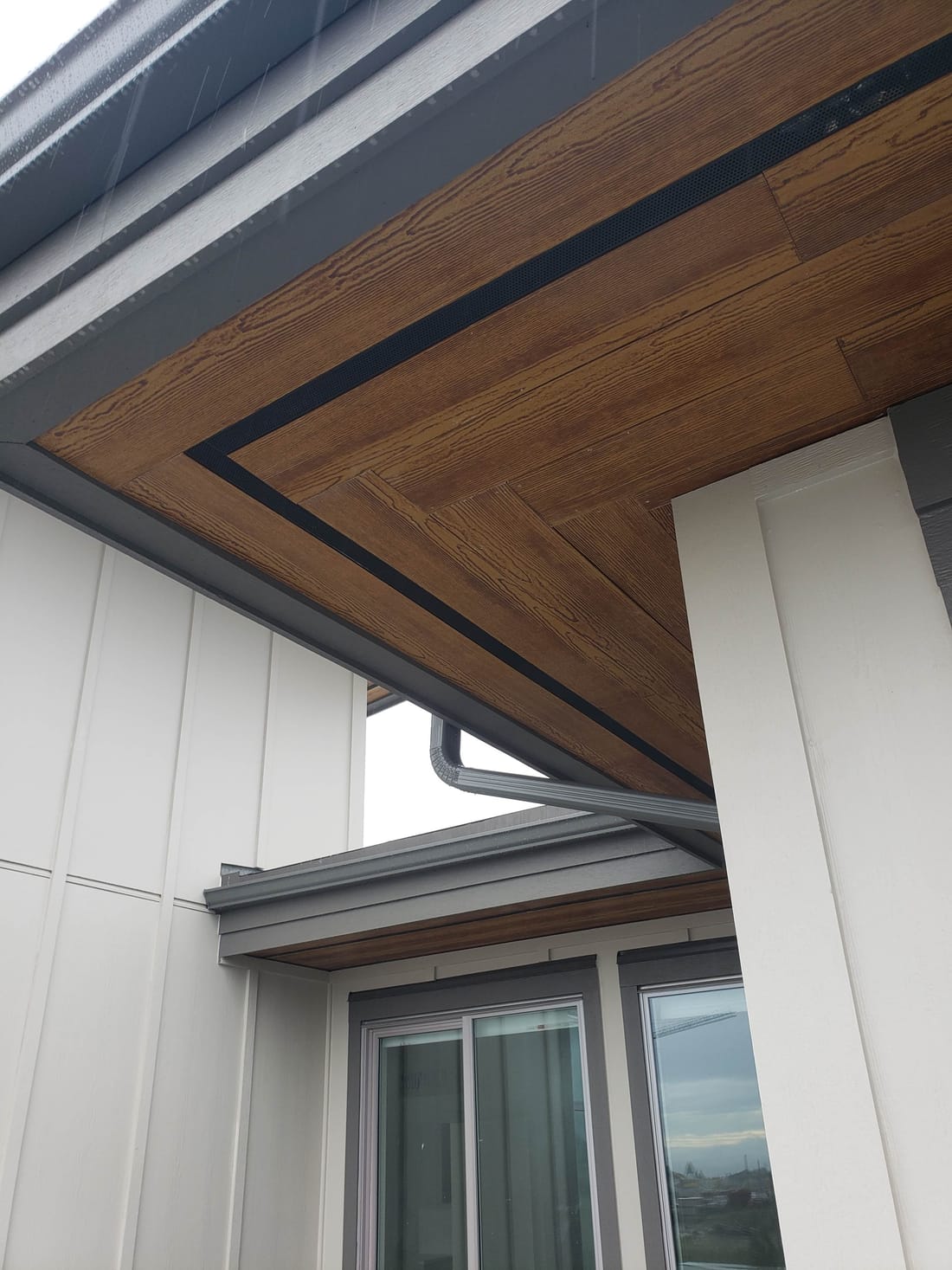
Soffit & Fascia in Coquitlam
Soffit and fascia for Coquitlam, from Westwood Plateau and Burke Mountain homes with complex rooflines to Maillardville and Austin Heights houses on their original eaves.
Built for how Coquitlam weathers.
Coquitlam rooflines take more water the higher up the hill you go. Plateau and Burke Mountain homes see slope-level rainfall on rooflines that are often complicated: multiple gables, dormers, and long runs of fascia with several transitions where water concentrates. Tree cover across the upper neighbourhoods keeps gutters loaded with debris, and an overflowing gutter on those elevations soaks the fascia from behind through an entire winter. Lower in the city, mid-century houses through Austin Heights and Harbour Chines are frequently still on original wood soffit with minimal venting. We size intake venting for the attic rather than replacing like for like, and we look at the gutter capacity that caused the problem in the first place.
Coquitlam ranges from 1990s executive homes on Westwood Plateau, many with aging cedar and stucco combinations, to new Burke Mountain builds and older homes in Maillardville.
Soffit does two jobs: it closes off the underside of your eaves against weather and pests, and it feeds the attic ventilation your roof needs to avoid condensation and premature failure. We install vented aluminum soffit systems sized to your attic's airflow requirements.
- Vented and solid aluminum soffit
- Attic ventilation sizing
- Colour matching to fascia and siding
- Pest and bird blocking
- Repair of sagging or wind-damaged sections
- Standalone or bundled with siding work
How we run soffit & fascia in Coquitlam.
Roofline inspection
We check panel condition, venting area and any signs of pests or moisture in the eaves.
Scope and colour match
Written quote with venting calculations and colour options matched to your trim.
Install
Old material removed, framing checked, new soffit installed with clean edges and secure fastening.
Soffit & Fascia in Coquitlam: what owners should know.
Rooflines Get Harder as Coquitlam Climbs
Coquitlam roofline work changes character with elevation, and the upper neighbourhoods present a genuinely harder problem than the valley floor.
Plateau and Burke Mountain homes were built with complicated roofs: multiple gables, dormers, varied pitches and long fascia runs with several transitions where water concentrates. More rain falls on them than on the flats, and tree cover across the upper slopes keeps gutters loaded with debris through autumn.
Put those together and you get the classic Coquitlam roofline failure: a gutter blocked by needle and leaf litter, overflowing at a valley or transition where the roof already concentrates water, running down the back of the fascia all winter where nothing is visible from the ground.
Fascia Rots From Behind
The sequence is consistent enough to predict.
A gutter blocks or its slope goes off. Water backs up and spills over the inner edge rather than the outer one, running down the back face of the fascia board. The board stays wet through a Coquitlam winter, softens, and the gutter fasteners lose their bite in the softened wood.
The first thing most owners notice is the gutter sagging or pulling away. By that point the rot has usually reached the sheathing edge and the rafter tails, so what presented as a gutter problem is now a structural repair.
On Plateau houses this is worse than average because the roof geometry concentrates water at specific points. A valley dumping onto a short gutter run overwhelms it in heavy rain regardless of how clean it is, and that same spot fails repeatedly until the drainage capacity is addressed rather than just the rotted board.
This is why we inspect the back face of the fascia and the structure behind it rather than quoting from the ground, and why our assessment includes gutter and downspout capacity. Replacing a rotted board without fixing what soaked it just resets the clock.
The Valley Floor Problem Is Different
Down through Austin Heights, Harbour Chines, Cape Horn and Maillardville, the housing is older and the failure is usually ventilation rather than water volume.
Mid-century houses in these neighbourhoods were frequently built with solid wood soffit and minimal or no venting. Some had vents cut in later, usually too few for the attic area, and decades of repainting have closed a lot of those.
The consequence is an attic with no reliable intake air. Moisture generated inside the house rises, cannot escape, and condenses on the cold underside of the roof sheathing. Over successive winters that produces staining, mould, damp insulation that loses much of its effective value, and shingles degrading from below, all in houses that have never had an actual roof leak.
How Attic Ventilation Actually Works
It is a two-part system. Soffit vents bring cool dry air in at the eaves, roof or ridge vents exhaust warm moist air at the top, and the resulting airflow carries moisture out of the assembly. Block the intake and the exhaust cannot function, because air has to come from somewhere.
Two things break it routinely.
Insulation. When attic insulation is topped up and pushed out toward the eaves, it frequently buries the soffit vents entirely. The attic is now better insulated and considerably worse ventilated, and moisture problems start the following winter. Baffles at the eaves keep the air path open, and installing them is a normal part of doing this work properly.
Paint. Perforated soffit repainted enough times has functionally sealed vents that still look correct from the ground.
When we quote we calculate the intake area the attic actually requires rather than replicating what was there, because replacing an under-vented soffit with an equally under-vented one solves the appearance and none of the physics.
What We Install
Vented aluminum soffit in a range of profiles and colours, sized for the required intake area, with eave baffles where insulation would otherwise block airflow. Vent patterns chosen with debris loading in mind on the tree-covered upper slopes, since a perforation pattern that clogs by November is not working in December.
Custom-bent aluminum fascia formed on site to follow your roof edge, specified to carry gutters loaded with water through a Coquitlam storm. Forming on site matters on Plateau houses where rooflines have many transitions and stock lengths do not follow the existing line accurately.
Structural repair first where rafter tails or the sheathing edge have gone, because covering rot is not a repair.
Aluminum suits this application: it does not rot, needs no refinishing, and holds its finish through wet winters and sun-exposed south slopes alike. On Burke Mountain contemporary builds, Longboard woodgrain aluminum soffit is a common upgrade where the underside of a deep overhang is visible and the owner wants a wood look with no maintenance.
Roofline Work On Its Own
Soffit, fascia and gutters form a self-contained system. You do not need to reclad to renew them, and we do not bundle work you do not need.
If the walls below are also near end of life we will say so and price both, because doing roofline work and then recladding a year later means paying twice for difficult access on a multi-level Plateau house. But if the siding has years left, replacing the roofline alone is the right call and that is what we will quote.
When we are already recladding a Coquitlam house we fold the roofline in, since the roof edge is usually the same age as the walls, the staging is up, and a new wall under a failing eave is a short-lived improvement.
When to Call
Sagging or stained soffit. Gutters pulling away, holding standing water, or overflowing at the same spot every heavy rain. Peeling fascia paint, especially where overflow runs. Gaps at the roof edge where birds or wasps have entered. Moss visible in the soffit perforations. Daylight from inside the attic. Frost, condensation or musty air in the attic in winter.
Call (672) 771-6868. Coquitlam is about twenty minutes from our Maple Ridge shop, and we will inspect the full roofline including the attic intake path, then give you a written quote at no charge.
Soffit & Fascia questions in Coquitlam.
Soffit & Fascia quotes in Coquitlam.
Tell us about your Coquitlam project and we will respond within one business day to book a free site visit, then follow up with a clear, line-itemed quote.