
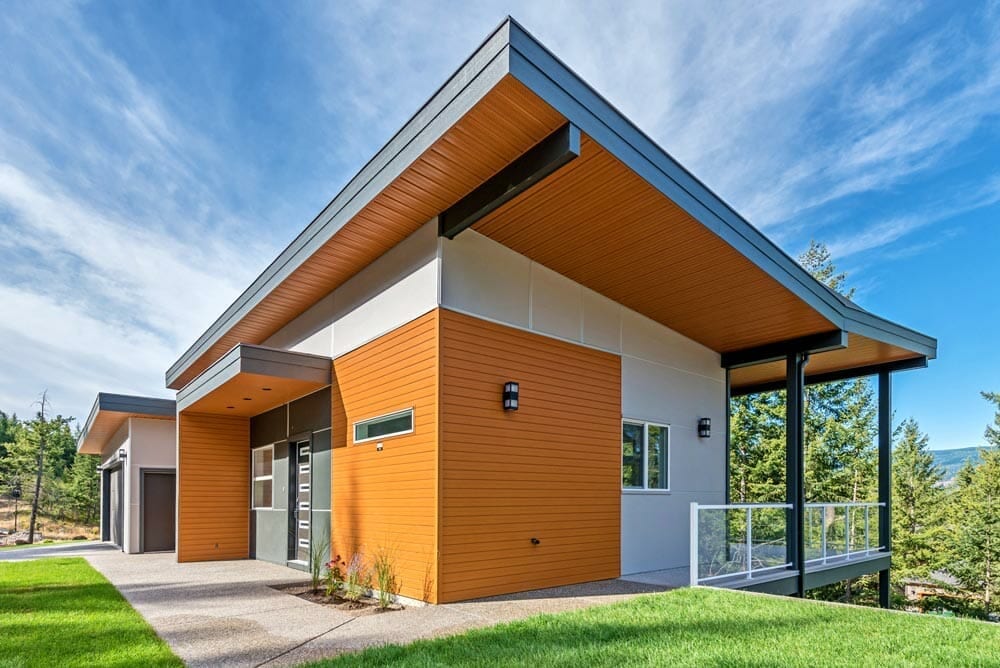
Lux Panels
Lux steel panels bring sharp modern profiles and durable factory finishes to Lower Mainland exteriors. Berkana Construction installs Lux flat and ribbed panels plus woodgrain planks on residential and commercial projects.
What you are getting.
Lux Architectural Panel is a Canadian-made steel cladding line offering flat panels, ribbed profiles and convincing woodgrain finishes. Steel brings dent resistance and strength, and the finishes carry strong fade warranties. It pairs beautifully with Hardie and works on everything from feature gables to full commercial facades.
- Canadian-made architectural steel
- Flat, ribbed and plank profiles
- Woodgrain and solid colour finishes
- High dent and impact resistance
- Non-combustible cladding
- Strong finish fade warranties
Where this material shines.
Gables & Accents
Woodgrain steel where it draws the eye.
Modern Homes
Ribbed and flat panel full exteriors.
Commercial
Tough cladding for busy frontages.
Shops & Garages
Steel durability for working buildings.
How we install it.
Profile and finish
Panel profile and finish selected against your design and budget.
Precision layout
Panel courses and trims laid out for balanced, aligned elevations.
Install
Panels cut and fastened with manufacturer trims for a sealed, crisp assembly.
Services that use this material.
Siding
Complete siding services for houses, townhomes and commercial buildings: installation, repair and full replacement in every major cladding material.
Siding Installation
New siding installed on homes, additions and commercial buildings, in fiber cement, vinyl, cedar, engineered wood and modern panel systems.
Siding Repair
Cracked, loose, rotten or storm-damaged siding repaired and colour-matched, before small problems become water damage.
Siding Replacement
Full tear-off and replacement of aging or failing siding, with substrate repairs, modern weather detailing and your choice of material.
Lux Panels: what Lower Mainland owners should know.
Lux Steel Panels: Canadian Steel for Canadian Weather
Steel is the cladding people forget to consider. Conversations about metal siding in the Lower Mainland tend to jump straight to aluminum, yet steel panel systems, and Lux in particular, bring a distinct set of strengths that make them the right answer on a meaningful share of projects. Lux panels are manufactured in Canada, formed from coated steel, and offered in a family of profiles that runs from sleek architectural flats to woodgrain planks. For owners who want metal's permanence with a firmer, tougher character, steel deserves a seat at the table, and we make sure it gets one whenever we quote a project.
What follows is a working guide to the Lux system: the profiles, the woodgrain steel that has been winning over skeptics, how finish warranties work in general terms, and the honest trade-offs between steel and aluminum, since we install both and have no stake in which one you choose.
A Canadian-Made System
Lux panels are produced domestically, which carries practical weight beyond sentiment. Lead times are shorter and more predictable than offshore alternatives, colour matching and reorders draw on the same production line rather than a different batch from a different continent, and the product family was developed with Canadian climates in mind, from prairie temperature swings to coastal rain. For projects in Maple Ridge, Surrey or anywhere across the region, specifying a Canadian mill product keeps the supply chain refreshingly boring, and boring supply chains finish projects on schedule.
The Profile Family
Flat Panels
Lux flat panels deliver the smooth architectural read that modern design calls for: broad faces, crisp shadow-line joints, minimal texture. They clad feature volumes and full elevations on contemporary homes and give commercial siding projects a current, substantial face. Steel's rigidity is an asset here, since flat metal shows substrate honesty and stiffer material holds its plane well.
Ribbed Profiles
Ribbed panels add linear texture, casting fine parallel shadows that animate large walls and disguise the minor imperfections flat product would reveal. Ribs also add stiffness mechanically, letting the panel span imperfect strapping more gracefully. The look ranges from agricultural-modern to refined depending on rib spacing and colour, and it has become a west coast staple on garages, shops and upper-storey accents.
Plank Profiles
Plank-format steel installs in courses like traditional siding and carries the system's woodgrain finishes. This is the profile homeowners choose when they want familiar siding language, horizontal lines, in a material that ignores weather entirely.
Woodgrain Steel: Warmth Without the Upkeep
Printed and embossed woodgrain finishes on steel have matured to the point where visitors routinely mistake a plank wall for stained timber until they touch it. Tones run from pale, Scandinavian-flavoured grains through mid cedar hues to deep espresso characters, and because the finish is applied and cured at the factory, every plank matches and none of them will ever need staining. In a climate that greys real wood in a couple of seasons and demands recurring refinishing after that, woodgrain steel is a way of buying the look once and keeping it. Owners comparing the effect against natural material can read our cedar siding page for the other side of that bargain, and comparing both against aluminum woodgrains like Longboard usually comes down to profile preference and budget.
Dent Resistance: Steel's Signature Advantage
Here is where steel separates itself. Steel is substantially harder and stiffer than aluminum, and it shrugs off the daily insults that mark softer metals: flung gravel from a line trimmer, a ladder set carelessly, hail, a kicked ball, the general contact of an active household or a working storefront. Aluminum's softness means impacts tend to leave permanent dents; steel's springback means many of the same impacts leave nothing. For walls facing driveways, laneways, playgrounds, loading areas or sports nets, this single property often decides the specification. No cladding is invulnerable, and a determined impact will still crease steel, but its damage threshold sits well above most rivals, and that margin is exactly where real-world durability lives.
Finish Warranties, in Plain Language
Steel cladding finishes are typically backed by long manufacturer warranties covering film integrity, meaning the coating staying adhered rather than peeling or blistering, and resistance to excessive fading and chalking over spans measured in decades. The precise terms vary by coating system and colour, and warranty documents define thresholds for what counts as excessive. We would rather you read those documents than have us paraphrase numbers, so we supply current manufacturer literature with every steel quote. The general point stands: factory-cured coil coatings on steel are among the longest-warranted finishes in the exterior industry, and the era of rusty, chalky metal buildings reflects products from a different generation, not what modern coated steel does.
Two honest caveats belong here. Cut edges expose raw steel and rely on the coating system and correct detailing to stay protected, so field cuts must be handled to the manufacturer's requirements, a discipline our siding installation checklists enforce on every metal job. And in direct salt-spray environments, aluminum holds an inherent corrosion advantage, which is part of the next discussion.
Steel Versus Aluminum: The Real Trade-Offs
Since we install both metals, clients often ask us to referee. The honest scorecard looks like this.
Steel wins on dent resistance and rigidity, as covered, and its strength allows confident spans and flatter large panels. It typically prices favourably against comparable aluminum systems, and its thermal expansion is lower, meaning less seasonal movement to absorb at trims.
Aluminum wins on corrosion chemistry. It does not rust, full stop, while steel depends on its metallic and paint coatings for protection; scratch both metals to bare material and aluminum forgives while steel wants attention. Aluminum is lighter to handle and, in extruded plank form, offers deep interlock profiles steel sheet forming does not replicate. For oceanfront exposure, aluminum is usually our recommendation; for the vast majority of Lower Mainland properties that are rained on but not salt-sprayed, coated steel's protective systems are more than equal to the climate, and its toughness tips the scale.
Neither metal rots, burns, or feeds insects, and both leave vinyl and wood behind on lifespan. The choice is a nuance conversation, which is exactly what a side by side quote is for.
Care and Long-Term Ownership
Steel's ownership routine is brief. Rinse the walls once or twice a year, use mild soap where road film or barbecue smoke has settled, and keep sprinklers from spraying fertilizer-laden water against the base courses, since mineral deposits dull any finish. Inspect after major windstorms the way you would any cladding, and if a scratch ever exposes bare metal, touch it up promptly with the manufacturer's recommended method so the coating system stays continuous. That is the entire manual. There is no staining calendar, no caulk renewal on the panel field, and no repaint looming a decade out, which is why lifetime cost comparisons between steel and painted claddings look very different from their day-one price comparisons. Owners who track expenses across twenty years of a building's life tend to become metal cladding's loudest advocates.
Where Lux Fits in the Lower Mainland
We reach for Lux steel on modern homes wanting flat or ribbed metal with a firmer feel, on plank projects where woodgrain durability leads the brief, on garages, shops and outbuildings that earn their keep, and on commercial faces where impact traffic is a fact of life. It pairs handsomely with concrete, dark window frames and natural wood accents, and it holds its looks with nothing more than an occasional wash. Berkana Construction Management has quoted and installed steel beside aluminum, fibre cement and wood across the region since 2019, so when we say steel fits a project, the claim has competition behind it.
Put Steel on Your Shortlist
If your project could use cladding that treats a hailstorm as a non-event, call Berkana Construction Management at (672) 771-6868. We serve the entire Lower Mainland from Maple Ridge and will bring Lux profiles and woodgrains to your site with a comparison quote across every system we install.
Common questions, lux panels.
Get a free written quote.
Tell us about your building and what you have in mind. We respond within one business day to book a free site visit, then follow up with a clear, line-itemed quote.