
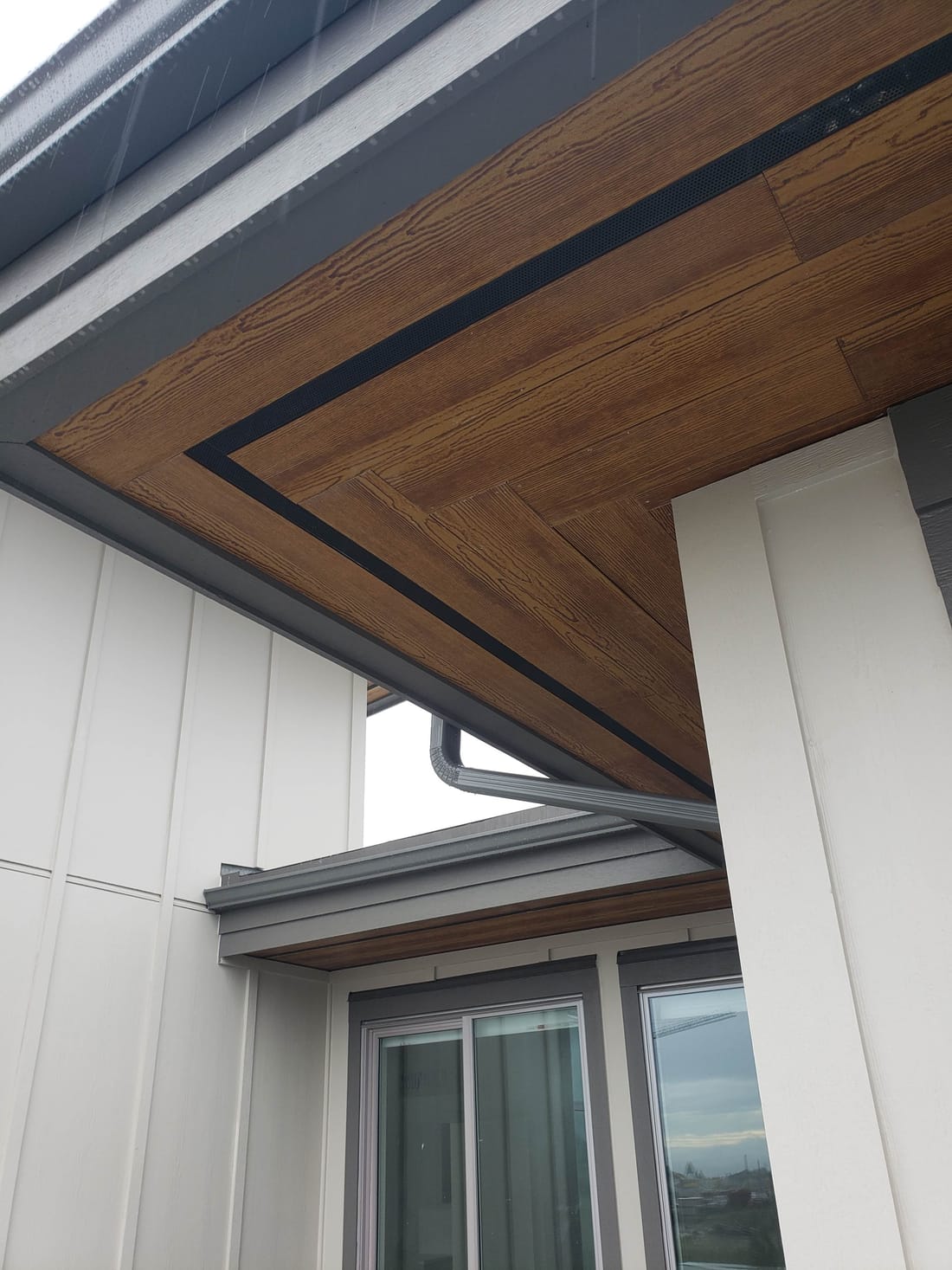
Soffit & Fascia Repair in Surrey
Soffit and fascia repair across Surrey, where big two-storey homes carry long roofline runs and decades of gutter overflow have quietly rotted the boards behind them.
Built for how Surrey weathers.
Surrey's large 1980s and 1990s family homes carry a lot of roofline, and length works against you: more fascia to keep straight, more gutter to keep clear, and more places for an overflow to sit unnoticed. The most common Surrey call is fascia that has softened from behind where a gutter has been overflowing for years, usually discovered when the gutter itself starts to sag or pull away. Open exposures through Cloverdale and Panorama Ridge add wind that gets under soffit panels fastened for a gentler climate. We replace with vented aluminum soffit and custom-bent fascia formed on site, and we repair the rafter tails and sheathing edge underneath rather than covering rot with new material.
Surrey mixes large 1980s and 1990s family homes in Fleetwood and Guildford, many with original vinyl now brittle and faded, alongside newer Clayton and Grandview Heights builds.
Soffit does two jobs: it closes off the underside of your eaves against weather and pests, and it feeds the attic ventilation your roof needs to avoid condensation and premature failure. We install vented aluminum soffit systems sized to your attic's airflow requirements.
- Vented and solid aluminum soffit
- Attic ventilation sizing
- Colour matching to fascia and siding
- Pest and bird blocking
- Repair of sagging or wind-damaged sections
- Standalone or bundled with siding work
How we run soffit & fascia repair in Surrey.
Roofline inspection
We check panel condition, venting area and any signs of pests or moisture in the eaves.
Scope and colour match
Written quote with venting calculations and colour options matched to your trim.
Install
Old material removed, framing checked, new soffit installed with clean edges and secure fastening.
Soffit & Fascia Repair in Surrey: what owners should know.
Long Rooflines, Long Problems
Surrey's big 1980s and 1990s family homes carry a lot of roofline, and length works against you in ways owners rarely anticipate.
More fascia means more board to keep straight and more places for a fixing to loosen. More gutter means more run to keep clear and more opportunity for a blockage. And critically, a long roofline gives an overflow more places to sit unnoticed. On a small bungalow you notice a gutter problem quickly. On a two-storey Fleetwood or Guildford house with fifty feet of fascia across the back, an overflow at one end can run for years before anything visible happens at the front.
The Failure Nobody Sees Coming
By far the most common Surrey roofline call is fascia that has rotted from behind.
The sequence is always the same. A gutter blocks or its slope goes off. Water backs up and spills over the inner edge rather than the outer one, running down the back face of the fascia board where nothing is visible from the ground. The board stays wet through the winter, softens, and the gutter fasteners lose their bite in the softened wood.
The first symptom most owners notice is the gutter sagging or pulling away, and by that point the rot has usually reached the sheathing edge and the rafter tails behind it. What looked like a gutter problem is now a structural repair.
This is why we inspect the back face of the fascia and the structure behind it rather than quoting from the ground. Replacing a rotted fascia board without repairing the rafter tails underneath produces a new board that loses its fixings within a few years.
Wind Damage on Exposed Elevations
Surrey's open terrain adds a second failure mode. Cloverdale, Panorama Ridge and Fraser Heights face long unobstructed wind fetches, and storm gusts get under soffit panels that were fastened for a gentler climate.
Once a panel lifts, the roof edge is open. Wind-driven rain enters the eave directly, wets the attic insulation at the perimeter, and the damage moves inward from there. After a windstorm, lifted soffit deserves the same urgency as lifted siding.
We fasten soffit on exposed Surrey elevations more conservatively than on sheltered lots, because the wind loading genuinely is different here.
Attic Ventilation, and Why It Matters on a Big House
Soffit vents are the intake half of your attic ventilation. Roof or ridge vents exhaust warm moist air at the top, soffit vents bring cool dry air in at the eaves, and the resulting airflow carries moisture out of the assembly. Block the intake and the exhaust cannot function, because air has to come from somewhere.
Large houses generate more interior moisture and have more attic volume to ventilate, so intake area matters proportionally more. Under-vented soffit on a big Surrey home produces condensation on the underside of the roof sheathing, damp insulation that loses much of its effective R-value, mould, and shingles degrading from below.
The most common way this gets broken is insulation. When attic insulation is topped up and pushed out toward the eaves, it frequently buries the soffit vents entirely, leaving a better-insulated and much worse-ventilated attic. Baffles at the eaves keep the air path open, and installing them is a normal part of doing this properly.
When we quote, we calculate the intake area the attic actually needs rather than replicating what was there, because replacing an under-vented soffit with an equally under-vented one solves the appearance and none of the physics.
What We Install
Vented aluminum soffit in a range of profiles and colours, sized for the required intake area, with baffles where insulation would otherwise block airflow. Aluminum suits this application: it does not rot, needs no painting, and holds its finish through Surrey winters and summer UV.
Custom-bent aluminum fascia, formed on site to follow your roof edge, specified to carry gutters loaded with water through a storm. Forming on site matters on long runs, where stock lengths and factory bends do not follow the existing line accurately across a whole elevation.
Structural repair first where rafter tails or the sheathing edge have gone. Covering rot is not a repair.
We also look at gutter and downspout capacity as part of the assessment, because on a long roofline the actual root cause is often undersized gutters or too few downspouts. Fixing the fascia without fixing the drainage that soaked it just resets the clock.
Roofline Work On Its Own
Soffit, fascia and gutters form a self-contained system. You do not need to reside your house to renew them, and we do not bundle work you do not need.
If the walls below are also near end of life we will say so and price both, because doing roofline work and then recladding a year later means paying twice for the same staging on a two-storey house. But if the siding has years left, replacing the roofline alone is the right call and that is what we will quote.
When we are already recladding, we fold the roofline in. The staging is up, the access is paid for, and a new wall under a failing eave is a short-lived improvement.
When to Call
Sagging or stained soffit. Gutters pulling away, holding standing water, or overflowing in ordinary rain. Peeling fascia paint, particularly on the side where gutters overflow. Gaps at the roof edge where birds or wasps have gotten in. Daylight visible from inside the attic. Frost, condensation or musty air in the attic in winter.
Call (672) 771-6868. We will inspect the full roofline including the attic intake path, not just the section you asked about, and give you a written quote at no charge.
Soffit & Fascia Repair questions in Surrey.
Soffit & Fascia Repair quotes in Surrey.
Tell us about your Surrey project and we will respond within one business day to book a free site visit, then follow up with a clear, line-itemed quote.