
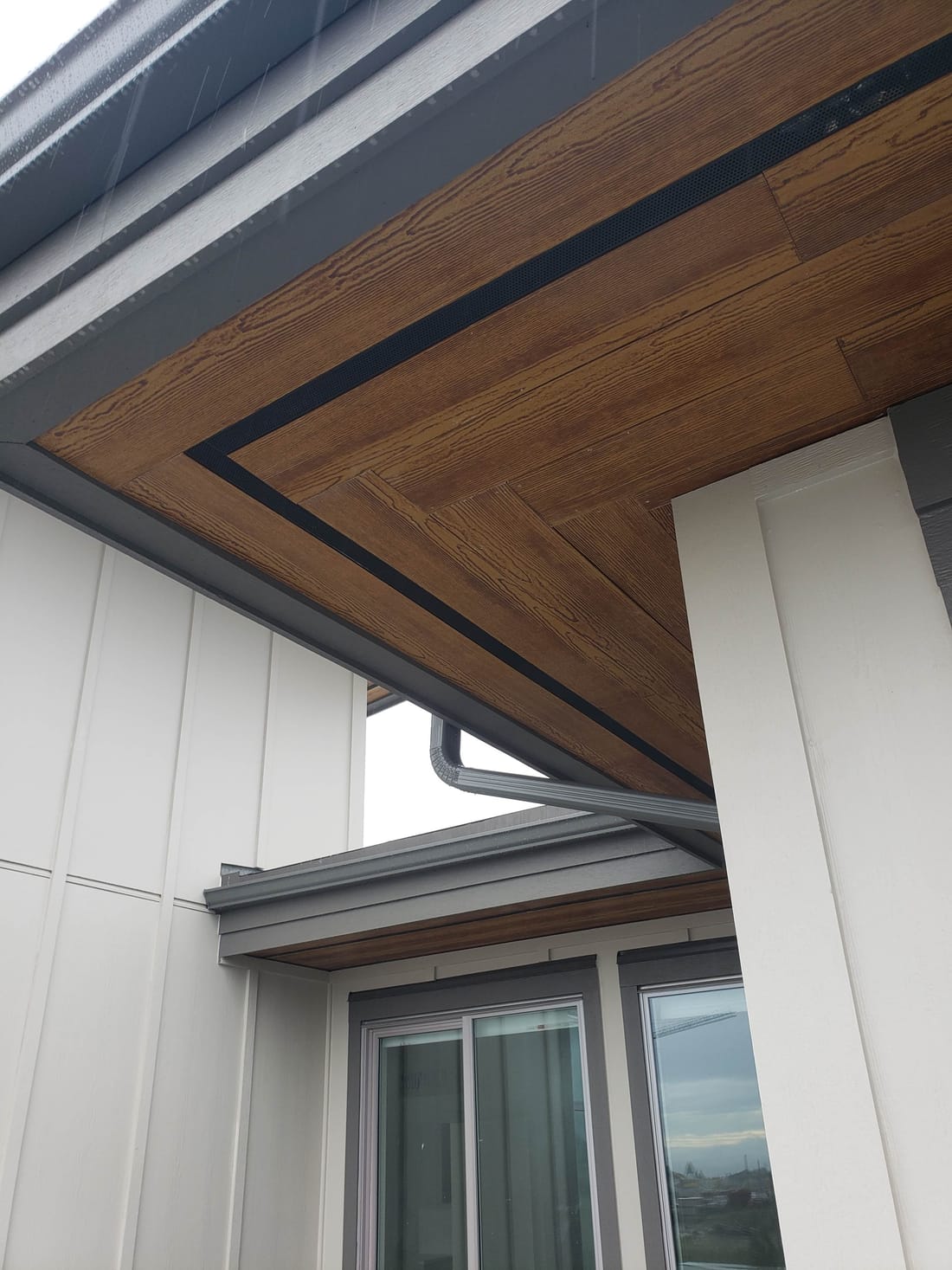
Soffit & Fascia in Richmond
Soffit and fascia for Richmond, where sea-level humidity makes attic ventilation the quiet workhorse of the whole house, and gutter-line rot hides behind fascia for years.
Built for how Richmond weathers.
Richmond attics work harder than most owners realise. The city sits at sea level with high ambient humidity and river fog through the cooler months, so the moisture load an attic has to shed is higher here than in drier municipalities, and the margin for blocked intake vents is smaller. We regularly find condensation and mould on roof sheathing in Richmond houses that have never leaked, traced to soffit vents painted shut, clogged, or buried under topped-up insulation. At the fascia line, the flat roofscapes of the 1980s and 1990s stock carry long gutter runs where an overflow soaks the board from behind through a whole winter before anything sags. We size intake venting for the attic, form fascia on site, and repair the structure underneath rather than covering rot.
Richmond's big 1980s and 1990s homes were commonly clad in cedar or stucco that is now three to four decades old, on flat delta lots with little natural runoff.
Soffit does two jobs: it closes off the underside of your eaves against weather and pests, and it feeds the attic ventilation your roof needs to avoid condensation and premature failure. We install vented aluminum soffit systems sized to your attic's airflow requirements.
- Vented and solid aluminum soffit
- Attic ventilation sizing
- Colour matching to fascia and siding
- Pest and bird blocking
- Repair of sagging or wind-damaged sections
- Standalone or bundled with siding work
How we run soffit & fascia in Richmond.
Roofline inspection
We check panel condition, venting area and any signs of pests or moisture in the eaves.
Scope and colour match
Written quote with venting calculations and colour options matched to your trim.
Install
Old material removed, framing checked, new soffit installed with clean edges and secure fastening.
Soffit & Fascia in Richmond: what owners should know.
At Sea Level, the Attic Does More Work
Soffit and fascia matter everywhere. In Richmond they matter for a reason specific to the delta: the city's humidity raises the moisture load every attic has to shed, while giving the rest of the house fewer ways to dry.
Richmond sits at sea level with high ambient humidity year-round, fog off the Fraser through the cooler months and a water table close beneath every lot. Moisture generated inside the house, from cooking, showers and simply living, rises into the attic carrying that load. The attic sheds it through ventilation: soffit vents drawing dry air in at the eaves, roof vents exhausting moist air at the top, continuous airflow in between.
When that system works, the attic stays dry. When the intake is blocked, Richmond's humidity means the margin for error is thinner than inland, and the consequences arrive sooner: condensation on the underside of the roof sheathing, staining, mould, insulation that dampens and loses much of its effective value, and shingles aging from below.
We find exactly this in Richmond houses that have never leaked a drop. The owners have usually spent months looking for the hole in the roof. There is no hole. The water came from inside, and the attic could not breathe it out.
How the Intake Gets Broken
Three ways, all common across the city's 1980s and 1990s stock.
Insulation over the eaves. The most frequent. Attic insulation gets topped up, gets pushed out to the edges, and buries the soffit vents completely. The house is now better insulated and worse ventilated, and the attic moisture problems begin the following winter. Baffles at the eaves hold the air path open through the insulation, and installing them is a standard part of doing this work properly.
Paint. Perforated soffit repainted enough times carries functionally sealed vents that look fine from the driveway.
Undersized venting from day one. Plenty of the original construction carried less intake area than the attic needed. Replacing it like for like preserves the shortfall, which is why we calculate the intake the attic actually requires rather than copying what was there.
Fascia Rot on the Flat Roofscapes
The fascia side of the Richmond story is about geometry. The city's 1980s and 1990s houses carry long, low roofline runs, and long runs work against you: more gutter to keep clear, more board to keep straight, and more places for an overflow to sit unnoticed.
The sequence is the same every time. A gutter blocks or loses its slope. Water spills over the inner edge and runs down the back face of the fascia, invisible from the ground. In Richmond's humidity the board never dries between events, so it softens faster than the same failure would inland. The gutter fasteners lose their grip in the softened wood, and the first visible symptom, a sagging gutter, arrives years after the rot started. By then it has typically reached the sheathing edge and rafter tails.
So we inspect from behind, and we repair the structure before new material goes on. Covering rot with new aluminum is not a repair; it is a countdown to the gutters falling off a clean-looking fascia.
What We Install
Vented aluminum soffit, sized by calculation for the attic it serves, in profiles and colours that suit the house. Baffles at the eaves wherever insulation would otherwise block the path. Aluminum is the right material at sea level: it does not rot, needs no refinishing and holds its finish through fog seasons that punish painted wood.
Custom-bent aluminum fascia, formed on site to follow the existing roof edge, specified to carry gutters loaded with winter volume. On Richmond's long runs, site forming is the difference between a straight line and an obvious wave.
Structural repair first where rafter tails or the sheathing edge have gone.
Drainage capacity checked as part of every assessment, because on long low rooflines the root cause is often an undersized gutter or too few downspouts, and fixing the board without fixing what soaked it just restarts the clock.
Near Steveston and the south dyke we specify corrosion-resistant hardware throughout, because marine air ages roofline metals and fasteners faster than anywhere else in the city.
On Its Own, or With the Walls
Soffit, fascia and gutters are a self-contained system. When the siding below has years of life left, we renew the roofline on its own, and that is what the quote says.
When walls and roofline are both due, one mobilization beats two: the staging is up, the access is paid for, and on the delta a new wall under a failing eave is a short-lived improvement, because the eave is where so much of the water enters. That is why soffit and fascia are folded into most of our Richmond recladding scopes by default. See siding replacement in Richmond.
When to Book a Look
Sagging or stained soffit. Gutters pulling away, holding water, or overflowing in ordinary rain. Peeling fascia paint where overflow runs. Gaps at the roof edge where birds or wasps have moved in. Daylight visible from inside the attic. Frost, condensation, damp insulation or musty air up there in winter.
Any one of these is worth twenty minutes of inspection. Call (672) 771-6868 and we will check the full roofline and the attic intake path, not just the section you noticed, and put a quote in writing at no charge.
Soffit & Fascia questions in Richmond.
Soffit & Fascia quotes in Richmond.
Tell us about your Richmond project and we will respond within one business day to book a free site visit, then follow up with a clear, line-itemed quote.