
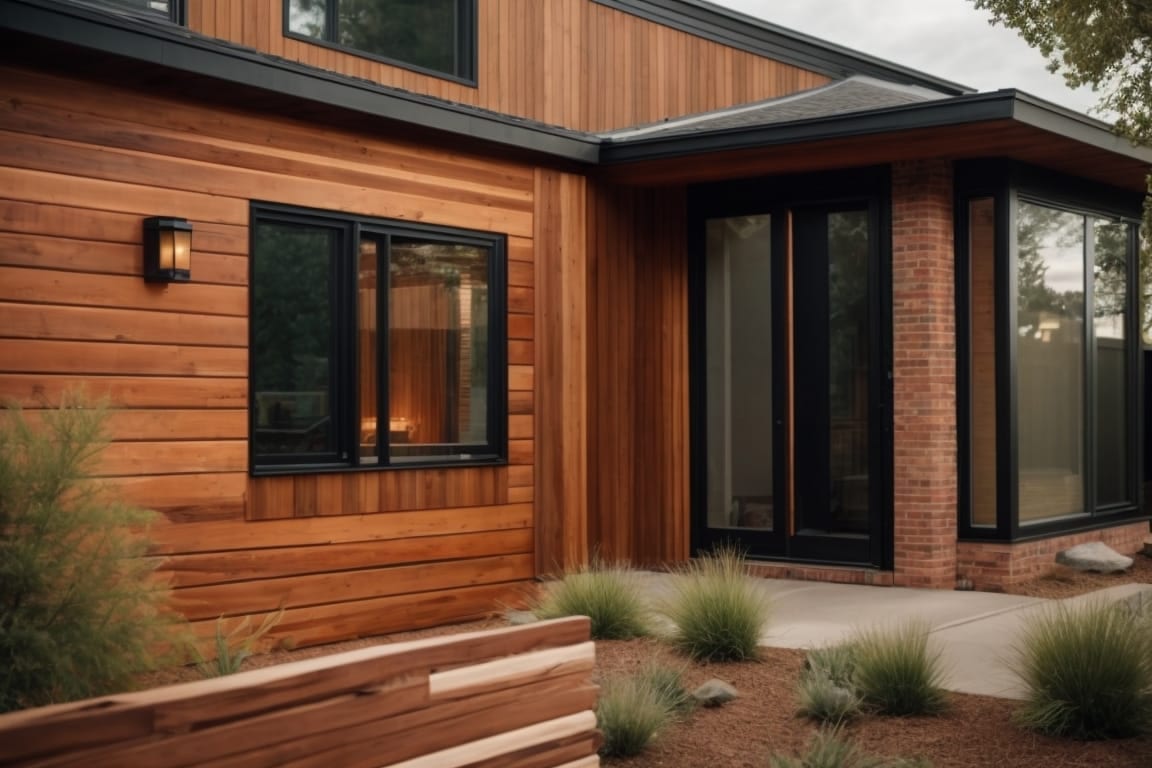
Cedar Siding in Vancouver
Cedar and wood siding in Vancouver: restoration on character homes where the original material is worth saving, and new cedar installed the way this climate requires.
Built for how Vancouver weathers.
Vancouver has more genuinely old wood siding than anywhere else we work. Pre-war houses through Kitsilano, Dunbar, West Point Grey and Mount Pleasant often still wear original bevel siding that has survived ninety years, and a surprising amount of it is sound under the paint. That changes the conversation: on a character home the default is restoration and selective board replacement rather than tear-off, both to preserve the street character and because the old-growth material is frequently better than what money can buy today. Where cedar does need replacing, we reproduce the original profiles, reveals and trim details, and rebuild the assembly behind it with the drainage and ventilation the wall never had.
Vancouver's housing stock runs from pre-war craftsman homes in Kitsilano and Dunbar to thousands of Vancouver Specials with original stucco, plus laneway houses and infill on tight lots.
Nothing matches real cedar for warmth and West Coast character, and no material punishes poor installation faster in our climate. We install Western Red Cedar bevel, channel and shingle profiles over a ventilated rainscreen with stainless fasteners and proper finishing, which is what separates cedar that silvers gracefully from cedar that rots.
- Western Red Cedar, clear and knotty grades
- Bevel, channel and board-and-batten
- Cedar shingle and shake sidewall
- Rainscreen and stainless fastening
- Stain, oil or natural weathering options
- Repairs and partial replacement
How we run cedar siding in Vancouver.
Grade and profile
Clear or knotty, bevel or channel, finish colour: chosen with samples against your home.
Rainscreen prep
Ventilated strapping and barrier so the wood can dry from both faces.
Install and finish
Stainless fasteners, sealed cuts and your chosen finish applied on schedule.
Cedar Siding in Vancouver: what owners should know.
Vancouver Has the Best Old Wood in the Region
This page starts with an argument against selling you a job.
Original siding on a pre-war Vancouver house is old-growth cedar or fir: slow-grown, tight-grained material with far more growth rings per inch than anything currently harvested. It is more dimensionally stable, more naturally rot-resistant and simply better than what money buys today. It has survived ninety years on Kitsilano, Dunbar, West Point Grey and Mount Pleasant streets because the wood is genuinely good.
So when we assess wood siding on a Vancouver character home, the first question is not what to replace. It is what to save. Tearing off sound old-growth siding to install new material is often a downgrade in material quality as well as a permanent loss of the building's fabric.
We tell owners that even when it means the smaller job.
What Actually Fails on a Character Home
Damage on old Vancouver wood siding concentrates at specific points rather than spreading evenly across walls, and knowing where to look tells you most of what you need.
Accumulation points. Watertables, window sills, corner boards, the bottom two or three courses, and anywhere trim creates a horizontal surface that holds water. These fail first, and they fail because of geometry and detailing rather than because the wood was poor.
Paint layer failure. Ninety years of repainting builds a thick, brittle film. When it cracks, water gets behind it and cannot escape, so the paint that was protecting the wood starts trapping moisture against it instead. Widespread paint failure looks alarming and frequently sits on top of perfectly sound boards.
Improvised flashing. Decades of small repairs leave a patchwork of details, some good, some caulk. Water entry at a bad detail can travel a long way before it shows.
Grade and vegetation contact. Siding buried by raised garden beds or held against shrubs stays wet and rots at the base.
None of that condemns a wall. All of it is repairable.
Restoration Versus Replacement
The assessment is physical, not visual. We probe the accumulation points, check the bottom courses, examine around every opening, look at watertables and sills, and take moisture readings where the picture is unclear.
Restoration makes sense when the boards are sound under the paint, failures are confined to specific details, and the sheathing behind is dry. That work involves removing failed paint layers where necessary, replacing individual boards that have genuinely gone, rebuilding watertables and sills to their original profile with the slope and flashing restored, correcting whatever detail let water in, and refinishing. It costs a fraction of recladding.
Replacement becomes right when soft wood is widespread rather than clustered, when several elevations are failing simultaneously, when the sheathing shows moisture damage, or when the assembly has no drainage path and will repeat the failure regardless.
When it is genuinely close, we show you the evidence with photographs and price both so the decision is yours.
Matching Historic Profiles
Original Vancouver siding profiles are not stock items, and this is where a lot of well-intentioned restoration work goes wrong.
Pre-war bevel and drop siding came in reveal dimensions that current production does not match. Watertables, corner boards and window casings were built to proportions specific to the era and the architectural style. Substituting the nearest modern equivalent produces a wall that is subtly but visibly wrong: reveals that do not line up with adjacent original work, trim that reads too thin or too wide.
Where a match matters we mill or source to the original dimensions. On a partial repair that is the difference between invisible and obvious, and on a heritage facade it is the difference between restoration and replacement in appearance if not in fact.
New Cedar, Installed for This Climate
When cedar is going back on, whether as selective replacement boards or a full elevation, it goes on prepared properly.
Boards get back-primed and end-sealed so all six sides are protected, because end grain absorbs water many times faster than face grain and unsealed cuts are the single most common cause of premature rot. Fasteners are stainless, since ordinary fasteners react with cedar's natural tannins and produce the black streaking visible on older walls. Clearances at grade, decks and roofs are generous.
Where the assembly allows, we install over a ventilated rainscreen so the wall can drain and dry. On a full reclad that is standard. On a partial repair to an existing face-sealed wall we improve what we can within the constraint and are honest about what we cannot change without a larger project.
Finish and Maintenance
Cedar in Vancouver needs refinishing on a schedule, and the interval depends on the elevation rather than the house.
North-facing walls and anything under tree cover stay damp longer, see less drying sun and degrade finishes faster. South and west elevations take more UV but dry quickly. A single refinishing interval quoted for a whole house is a simplification; we set expectations per elevation.
The single highest-return maintenance action a cedar owner can take is refinishing on schedule rather than waiting for visible failure. Once the finish has broken down and the wood has been absorbing water through a winter, the work required jumps from refinishing to repair.
If You Want the Look Without the Schedule
Some owners love cedar and accept the maintenance. Others love the look and do not want the commitment. Both are legitimate.
James Hardie fiber cement in cedarmill texture reproduces the grain and shadow line convincingly, does not rot, and holds a factory finish where field-applied stain fades early on shaded walls. Engineered wood sits between the two. Longboard woodgrain aluminum delivers the appearance permanently maintenance-free.
We quote whichever combination you want to compare, on your actual measured wall area. Call (672) 771-6868.
Cedar Siding questions in Vancouver.
Cedar Siding quotes in Vancouver.
Tell us about your Vancouver project and we will respond within one business day to book a free site visit, then follow up with a clear, line-itemed quote.