
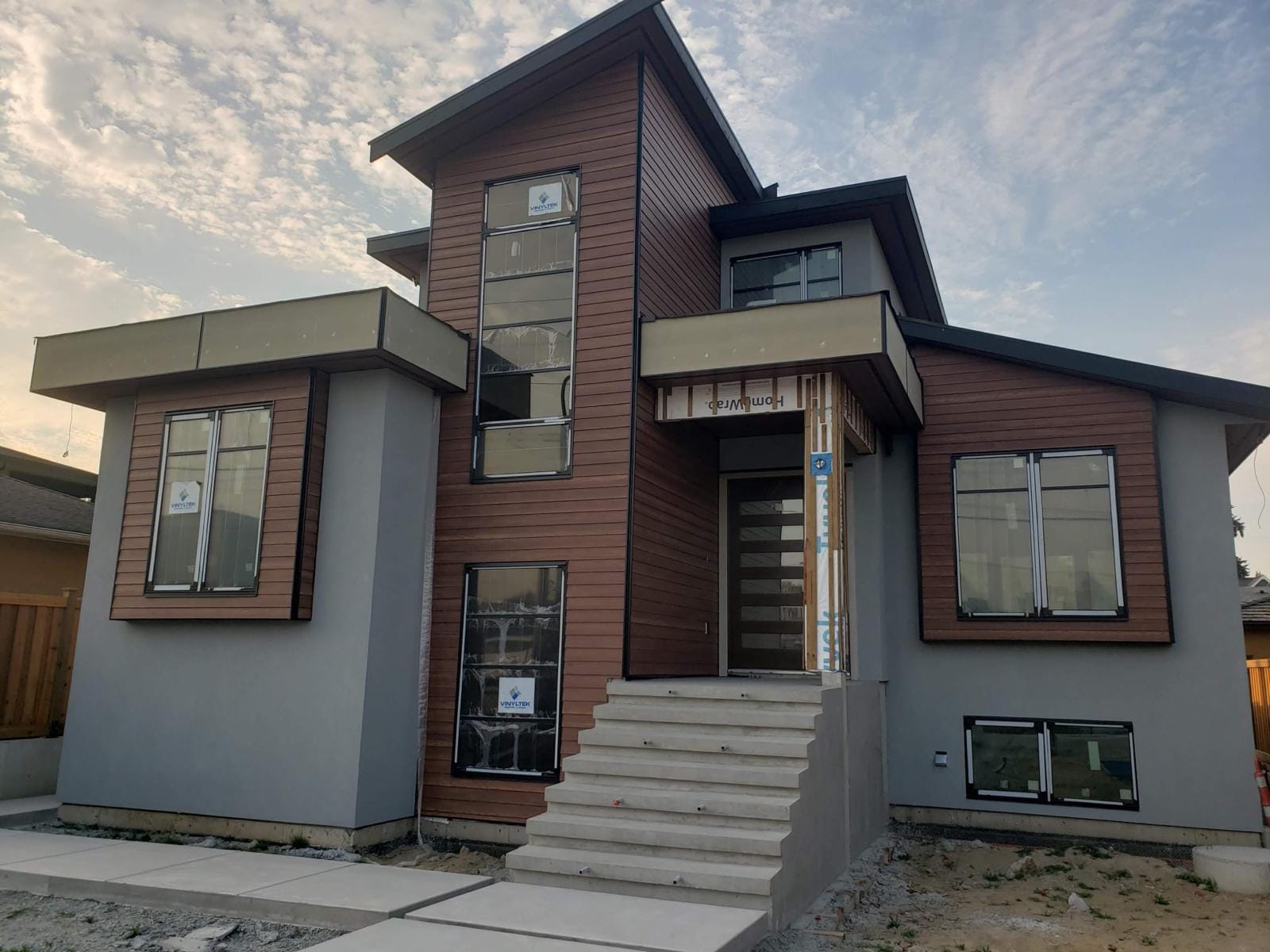
Siding Replacement in Richmond
Siding replacement in Richmond for homes whose original cedar or stucco has finished its service life in the delta's humidity. New walls built to drain, dry and last.
Built for how Richmond weathers.
When Richmond cedar or stucco from the 1980s finally fails, it usually fails broadly, because the whole wall lived through the same decades of fog and trapped moisture. Replacement here is really an envelope rebuild: new barrier, new flashing, a ventilated rainscreen and cladding chosen for humidity tolerance. Fiber cement and panel systems have become the default Richmond choice for exactly that reason. We also time tear-offs around weather windows so open walls are never caught exposed, which matters more at sea level than anywhere else.
Richmond's big 1980s and 1990s homes were commonly clad in cedar or stucco that is now three to four decades old, on flat delta lots with little natural runoff.
Replacing siding is the one chance to fix everything behind it: rot, missing barrier, bad flashing, no ventilation gap. We tear off to sheathing, repair what we find, rebuild the moisture layers to current standards and install the new cladding you choose.
- Complete tear-off to sheathing
- Rot and substrate repairs included in scope
- New weather barrier and rainscreen
- Upgrade material or match existing
- Insulation upgrade option during re-clad
- Disposal and recycling of old cladding
How we run siding replacement in Richmond.
Assessment and options
We inspect the existing walls and quote replacement options in two or three materials so you can compare.
Tear-off
Old cladding removed and disposed of. Sheathing inspected and moisture checked.
Repairs and barrier
Rot repaired, new weather barrier and rainscreen strapping installed.
New siding
Your chosen system installed to spec with new flashing and trim throughout.
Final walkthrough
Cleanup, magnet sweep for fasteners, walkthrough and warranty package.
Siding Replacement in Richmond: what owners should know.
Replacement in Richmond Is an Envelope Rebuild
When Richmond cladding from the 1980s and 1990s finally fails, it usually fails broadly, because the whole wall lived through the same decades of humidity with the same assembly working against it. That makes replacement here less a cosmetic refresh than a rebuild of how the wall handles water, and the rebuild is where the value sits.
The original assembly was face-sealed: cladding over building paper directly on the sheathing, no drainage cavity, no ventilation, standard practice when Broadmoor, Garden City, East Cambie and Thompson were built out. Face-sealed walls depend on caulking and paint keeping every drop out forever. On a delta where walls dry slower than anywhere else in the region, that bet has been losing quietly for thirty years.
What Tear-Offs Reveal Here
We tell Richmond owners during quoting that hidden damage is more likely here than the exterior suggests, because the city's slow-drying climate lets problems progress invisibly for years.
The recurring finds are damp or stained sheathing on elevations that never showed a symptom, rot concentrated below windows and at the bottom of walls where wicking water finished its run, black staining down studs marking years of slow tracking, damage radiating from deck ledgers that were never properly flashed, and the soaked back faces of cedar boards that never had an air gap to dry into.
Houses with no history of visible leaks routinely carry some of this. All of it is fixable while the wall is open. None of it is fixable while it is closed, which is also why we never clad over existing siding: covering a Richmond wall seals its moisture history inside permanently.
The Process
Assessment and written scope. Every elevation inspected and probed, a line-itemed quote in writing at no charge, and a candid flag wherever we suspect hidden damage, with pricing for how we handle it if we are right.
Weather-window planning. Richmond adds a scheduling discipline: at sea level with no shelter from the Strait, an open wall caught by a storm takes on water fast. We sequence tear-offs so no more wall is open than we can close and protect, and open walls are never left exposed overnight.
Tear-off to sheathing. Everything comes off.
Substrate repair. Rotted sheathing replaced, damaged framing repaired, all photographed as we go and priced transparently rather than padded into the base number.
Barrier and flashing. New weather-resistive barrier, properly lapped and integrated with flashing at every window, door and penetration. Kick-out flashings at roof-to-wall intersections. Deck ledgers flashed correctly, a recurring weak point on houses of this era.
Rainscreen strapping. The upgrade that matters most in this city. A strapped, ventilated cavity is a Richmond wall's only reliable way to dry, and we size it generously because drying capacity is the binding constraint on the delta.
Cladding, trim and roofline. New siding and trim, and in most scopes new soffit and fascia while the staging is up, since Richmond attics depend on working intake ventilation more than most. See soffit and fascia in Richmond.
Documentation and walkthrough. Photographs of everything behind the wall before it was covered, and a walkthrough together before final payment.
Choosing the Next Cladding
The delta narrows the field in useful ways.
James Hardie fiber cement is the most common Richmond answer and arguably the strongest climate case for it anywhere in the region: dimensionally stable in constant humidity, immune to rot, indifferent to the moss and algae that shaded north walls grow, and finished in ColorPlus colours that stand up to the hard unshaded sun of the flat subdivisions. Non-combustible as well.
Cedar remains right for owners who want the real material, particularly on Steveston's older streets, and we install it the way the delta demands: rainscreen behind, six-side sealing, stainless fasteners. It carries a real finish schedule in this humidity, and we say so. Our cedar siding in Richmond page covers both the restoration alternative and new installation.
Aluminum systems, AL13 and Longboard woodgrain, are entirely indifferent to humidity and salt air, which makes them the low-maintenance choice near the water and on contemporary architecture.
Premium vinyl serves budget projects in Hamilton and East Cambie legitimately, provided the barrier and flashing behind it are done properly, because the cheapest cladding does not justify the cheapest assembly.
Richmond's houses are large, so wall area makes material choice a bigger cost lever here than owners expect. We quote two or three options side by side on your actual measurements.
Salt Air Specifications Near Steveston
West of No. 2 Road and along the south dyke, marine exposure changes the hardware conversation. Stainless fasteners throughout, corrosion-resistant flashings and trims, and finish systems rated for salt air. These are small line items that decide how a waterfront wall looks in year ten, and we specify them by default in those areas rather than as upgrades.
Exterior Insulation While the Wall Is Open
Richmond's 1980s and 1990s homes carry minimal wall insulation by current standards, with thermal bridging through every stud, and they are big houses, so the loss adds up.
Continuous exterior insulation added during recladding addresses the whole wall including the framing, and on the delta it has a second benefit: warmer sheathing condenses less moisture inside the assembly through the humid winter. The labour is largely already committed while the wall is open, so we price it as a clearly separated option.
Stratas and Permits
Richmond's pre-rainscreen townhome inventory is exactly the building population the leaky condo era exposed, and recladding it is as much assembly correction as appearance. For councils we provide assessment reports, phased pricing across budget years, and documentation owners can act on, with scheduling coordinated through property managers.
Like-for-like recladding on a single-family house generally does not require a building permit, while structural repairs, assembly changes and multi-family work often do. We confirm requirements with the City of Richmond during quoting and handle the application when one applies.
Call (672) 771-6868 for a free written quote based on a real site visit.
Siding Replacement questions in Richmond.
Siding Replacement quotes in Richmond.
Tell us about your Richmond project and we will respond within one business day to book a free site visit, then follow up with a clear, line-itemed quote.