
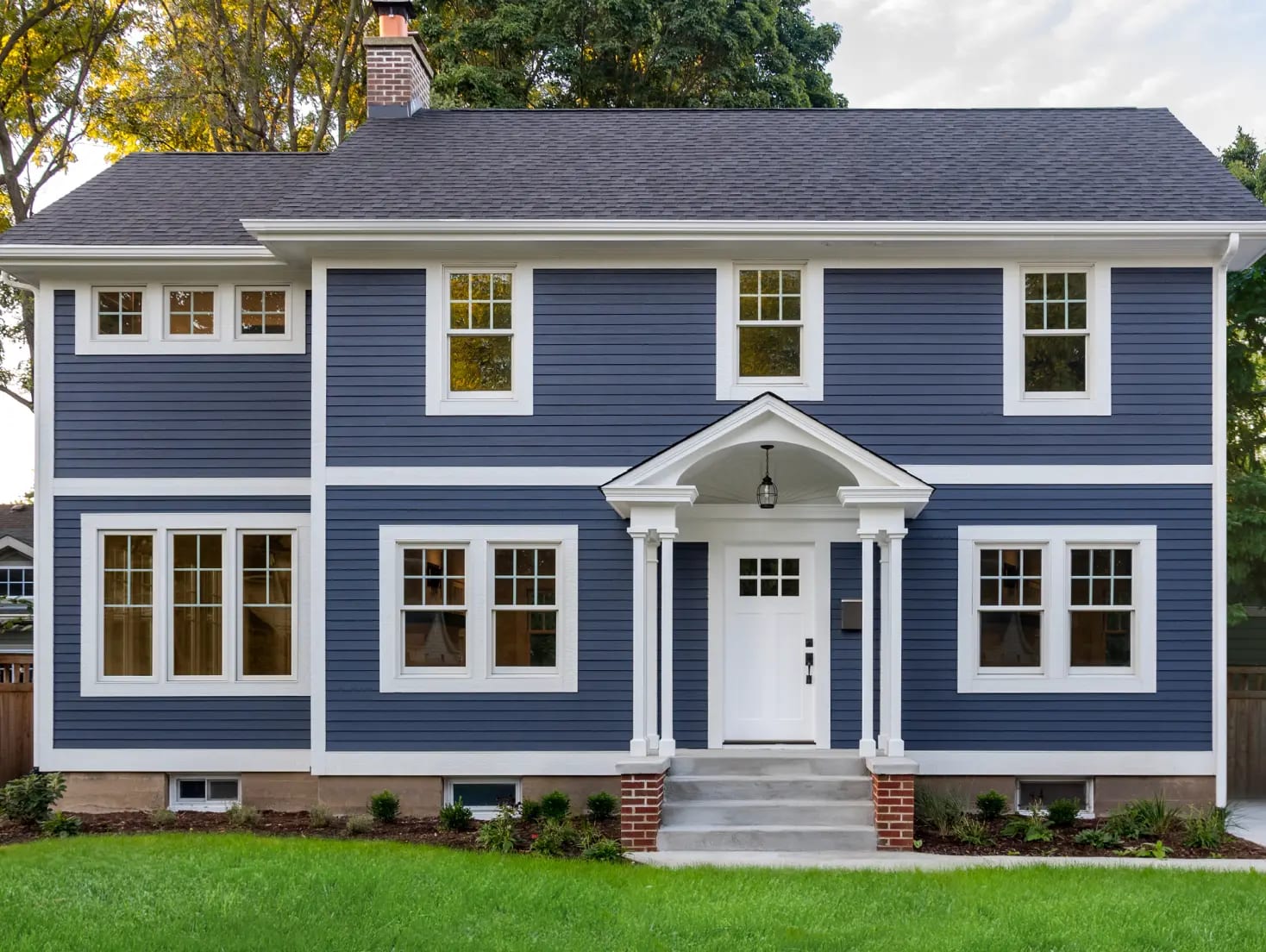
James Hardie in Richmond
James Hardie siding in Richmond: fiber cement that does not care about fog, humidity or salt air, replacing the cedar and stucco the delta wore out.
Built for how Richmond weathers.
Richmond may be the single strongest climate case for Hardie in Metro Vancouver. Fiber cement is dimensionally stable in constant humidity, immune to the rot that ended the city's original cedar, and pairs with a ventilated rainscreen to give sea-level walls the drying capacity they never had. Near Steveston we detail with corrosion-resistant fasteners and trims for the salt exposure. For owners replacing 1980s cladding, HardiePlank with ColorPlus is the low-maintenance ending to a thirty-year moisture story.
Richmond's big 1980s and 1990s homes were commonly clad in cedar or stucco that is now three to four decades old, on flat delta lots with little natural runoff.
James Hardie fiber cement is the benchmark siding for coastal BC. It does not rot, burn or feed insects, holds paint far longer than wood and carries one of the strongest warranties in the industry. The catch is that it must be installed exactly to spec, with correct clearances, flashing and fastening, which is where an experienced installer earns their keep.
- Fiber cement: will not rot, warp or burn
- ColorPlus factory finishes or site paint
- Plank, panel and shingle profiles
- Engineered for wet coastal climates
- Strong manufacturer warranty coverage
- Installed to Hardie best practices
How we run james hardie in Richmond.
Profile and colour
Plank, panel or shingle, ColorPlus or primed, chosen with samples in hand.
Assembly prep
Weather barrier, rainscreen and flashing detailed to Hardie's published requirements.
Spec installation
Correct gapping, clearances, fastening and touch-up, documented as we go.
James Hardie in Richmond: what owners should know.
Richmond May Be the Strongest Climate Case for Hardie
Every city we serve has a reason fiber cement fits. Richmond has three, and together they make the delta arguably the strongest climate case for James Hardie in the region.
It does not care about humidity. Richmond walls dry slower than anywhere else in Metro Vancouver: sea-level air, river fog, a high water table and flat, sheltered lots. Materials that absorb and release moisture cycle themselves to death here, and organic cladding rots wherever the detailing traps damp. Fiber cement is dimensionally stable in permanent humidity and simply does not rot. The failure mode that ended Richmond's original cedar does not apply to it.
It does not feed anything. Slow-drying north elevations and fence-shaded side yards in Richmond grow moss and algae readily. On wood, growth holds moisture against the surface and accelerates failure. On fiber cement it is a cleaning question, not a structural one.
Its finish survives the delta sun. The flat subdivisions east of No. 3 Road are largely treeless, and south and west walls take unshaded UV all summer. Field-applied paint fades and chalks on that exposure. ColorPlus factory finishes, baked on under controlled conditions, hold colour years longer and carry their own finish warranty.
Add non-combustibility and resistance to the wind-driven debris that Strait storms throw at west elevations, and the recommendation writes itself for most Richmond briefs.
The Standard Upgrade Path Here
Most Richmond Hardie projects start as a cedar or stucco story ending.
The city's 1980s and 1990s homes across Broadmoor, Garden City, Seafair and Thompson were commonly clad in cedar nailed tight to the wall, or face-sealed stucco, both now at or past end of life in this humidity. Owners weigh restoring the cedar against recladding, and when the boards are genuinely done, or the owner is done with finish schedules, HardiePlank in cedarmill texture is the natural landing: the grain and shadow line of the original, without the rot risk or the refinishing cycle. Our cedar siding in Richmond page covers that decision honestly, including when restoration is the better answer.
The equally important half of the upgrade happens behind the cladding. These walls were built with no drainage cavity, and recladding is the moment to correct it: new barrier, full flashing, and a strapped rainscreen sized for a wall that cannot count on drying. See siding replacement in Richmond for the full rebuild.
Profiles for Richmond Houses
HardiePlank lap siding carries most projects: cedarmill texture where the house is replacing cedar, smooth for cleaner contemporary looks, in reveals proportioned to Richmond's large two-storey elevations.
HardiePanel with battens or reveal trim for modern rebuilds and accent masses, increasingly common on the city's newer custom stock.
HardieShingle for gables and for Steveston work, where shingle detailing suits the village's older streets.
HardieTrim at corners, openings and transitions, sized to the house rather than defaulted, because trim proportion is most of what makes a reclad read right, particularly on character streets.
ColorPlus Versus Field Paint on the Delta
We quote both, and in Richmond the comparison tilts harder toward ColorPlus than almost anywhere.
Field painting needs dry application windows and cure time, which Richmond's fog season shortens, and the finished coat then faces the same two enemies that shorten every field finish here: long damp on the shaded elevations and hard UV on the sunny ones. ColorPlus is applied and baked in the factory, arrives cured, resists both failure modes measurably better, and removes the painting stage from the schedule entirely.
Primed-and-painted remains right where a specific custom colour drives the design, and for Steveston heritage palettes we price it willingly. For the typical Broadmoor or Terra Nova reclad, ColorPlus is the recommendation and we say so plainly.
Installation Is the Warranty
James Hardie's product warranty and the ColorPlus finish warranty are both conditional on installation meeting the manufacturer's published requirements. On the delta, the requirements that get skipped elsewhere are the ones that matter most.
Clearances at grade, decks and roof surfaces, which Richmond's flat lots, raised beds and hard landscaping constantly encroach on. Correct fasteners landing in framing, corrosion-resistant as standard and stainless near the salt air at Steveston and the south dyke. Flashing behind butt joints rather than sealant doing structural duty, because sealant in permanent humidity ages fast. Manufacturer gaps left at trim and openings rather than caulked tight.
And underneath it all, the rainscreen. Hardie can be direct-applied in dry climates. In Richmond the ventilated cavity is what protects the sheathing and framing, which are still wood no matter what covers them, in a city where wet walls stay wet.
While the Wall Is Open
Two additions earn their place in most Richmond Hardie scopes. Continuous exterior insulation, because these are big, under-insulated houses and warmer sheathing also condenses less moisture inside the assembly through the humid winter. And the roofline, because Richmond attics depend on working soffit intake more than most and the staging is already up. See soffit and fascia in Richmond.
Get a Written Quote
We measure every elevation, assess exposure and access, and put a line-itemed quote in writing at no charge, with Hardie priced against one or two alternatives on the same wall area, typically cedar restoration or engineered wood, so the comparison is real.
Call (672) 771-6868. Our crews cover Richmond year-round from our Maple Ridge base.
James Hardie questions in Richmond.
James Hardie quotes in Richmond.
Tell us about your Richmond project and we will respond within one business day to book a free site visit, then follow up with a clear, line-itemed quote.