
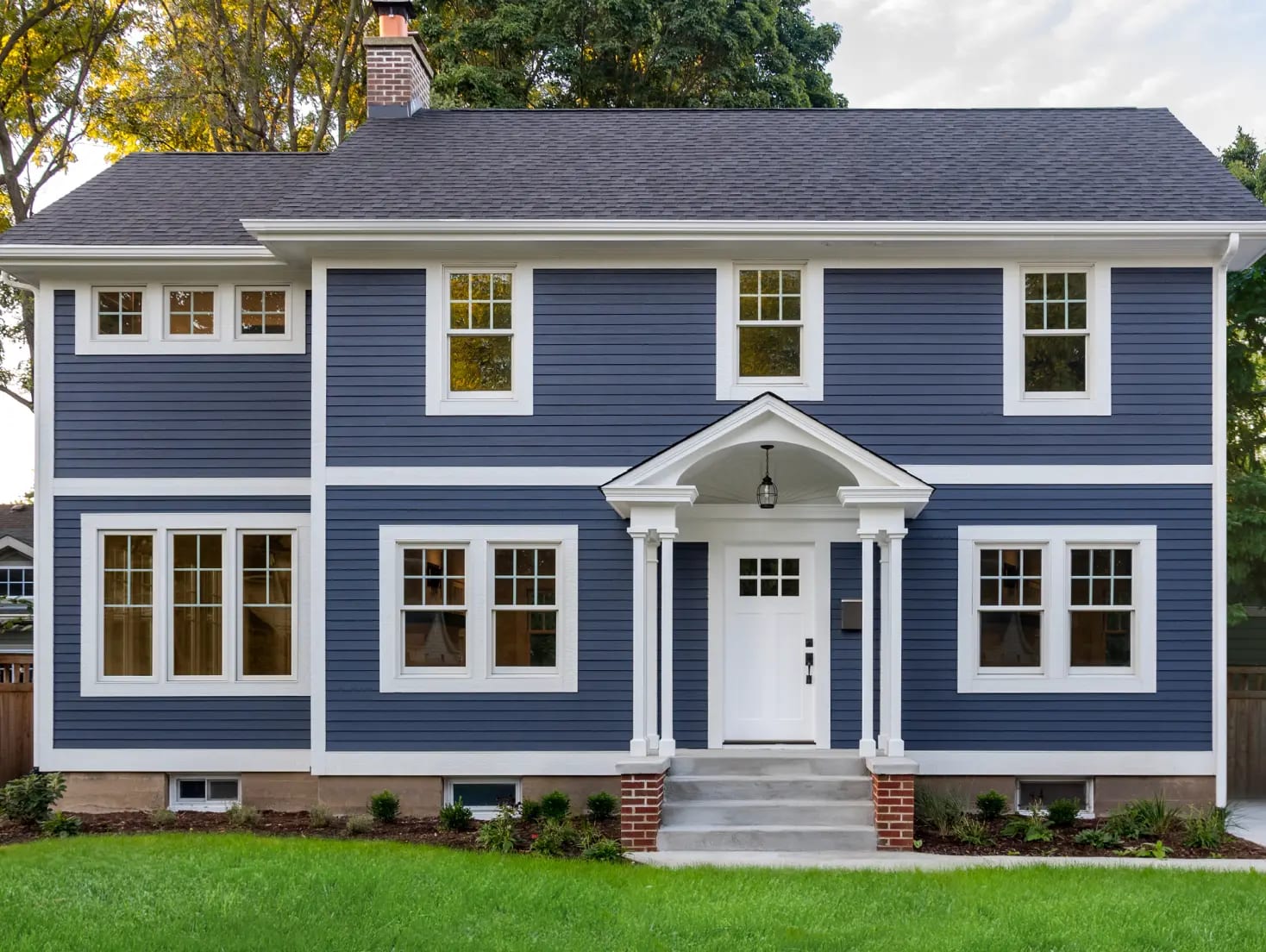
James Hardie in Surrey
James Hardie siding for Surrey homes: the step up thousands of owners choose when their original vinyl retires. Installed to spec, quoted side by side with the alternatives.
Built for how Surrey weathers.
The classic Surrey upgrade path runs straight through Hardie: original vinyl comes off, the wall gets rebuilt with proper barrier and rainscreen, and HardiePlank goes on with ColorPlus so the house never needs painting on a ladder again. On Surrey's big two-storey walls, fiber cement's wind and impact resistance pays for itself in avoided repairs, and the material shrugs off the UV that chalked out the vinyl. We are quoting more Hardie in Clayton, Fleetwood and Grandview every year, usually against engineered wood so owners see both numbers.
Surrey mixes large 1980s and 1990s family homes in Fleetwood and Guildford, many with original vinyl now brittle and faded, alongside newer Clayton and Grandview Heights builds.
James Hardie fiber cement is the benchmark siding for coastal BC. It does not rot, burn or feed insects, holds paint far longer than wood and carries one of the strongest warranties in the industry. The catch is that it must be installed exactly to spec, with correct clearances, flashing and fastening, which is where an experienced installer earns their keep.
- Fiber cement: will not rot, warp or burn
- ColorPlus factory finishes or site paint
- Plank, panel and shingle profiles
- Engineered for wet coastal climates
- Strong manufacturer warranty coverage
- Installed to Hardie best practices
How we run james hardie in Surrey.
Profile and colour
Plank, panel or shingle, ColorPlus or primed, chosen with samples in hand.
Assembly prep
Weather barrier, rainscreen and flashing detailed to Hardie's published requirements.
Spec installation
Correct gapping, clearances, fastening and touch-up, documented as we go.
James Hardie in Surrey: what owners should know.
The Standard Surrey Upgrade Path
There is a well-worn route in this city: original builder-grade vinyl from the 1980s or 1990s finally gives out, the owner looks at what to replace it with, and lands on fiber cement.
It is worth understanding why that path is so consistent, because the reasons are specific to Surrey rather than generic marketing.
UV and impact. What ended the original vinyl was decades of sun degrading the material until it went brittle and the colour chalked. Fiber cement does not become brittle with age and does not lose its finish the same way, and it resists the impact damage that cracks aged vinyl from a stray ladder or hailstorm.
Wind. Surrey's open terrain through Cloverdale, Panorama Ridge and Fraser Heights produces real wind loading. Fiber cement's weight and rigidity are an advantage where lighter cladding lifts.
Wall area. Surrey homes are big, and big wall areas mean more exposure to every failure mode, more repair calls over time, and more painting if you choose a material that needs it. Durability compounds on a large house.
Fire. Fiber cement is non-combustible, which matters in newer subdivisions with closer lot spacing.
Where the Cost Conversation Actually Lands
Because Surrey houses carry so much wall area, material choice moves the total more here than in most cities. A per-square-foot difference that is minor on a bungalow becomes a meaningful number on a two-storey Fleetwood family home.
That cuts both ways and we are straight about it. Fiber cement costs more upfront than premium vinyl. On a house you intend to keep for a decade or more, the durability, the elimination of the repaint cycle with ColorPlus, and the resale presentation generally make it the better value. On a rental property or a house you plan to sell soon, the arithmetic can legitimately favour vinyl.
We quote both on your actual measured wall area so the comparison is real rather than theoretical, and we give you our honest recommendation for your situation.
Profiles
HardiePlank lap siding is what most Surrey homes get. It suits the prevailing architecture directly and is the natural like-for-like upgrade from horizontal vinyl. Smooth or cedarmill texture, in a range of reveals.
HardiePanel in large-format vertical sheets with battens or reveal trim, which modernizes a 1980s or 1990s house more dramatically than a like-for-like swap. Increasingly common as an accent on gables and entries even when the main field is lap.
HardieShingle for gable accents and detailing.
HardieTrim at corners, windows and transitions. Trim is where fiber cement projects visibly succeed or fail, and substituting wood trim reintroduces the maintenance point you were trying to eliminate.
Most Surrey quotes we write combine profiles: lap on the field with panel or shingle accents to break up the large wall planes these houses have.
ColorPlus Is the Usual Recommendation
ColorPlus is Hardie's factory-applied baked-on finish. Applied under controlled conditions, it resists fading better than field paint, carries a separate finish warranty, and removes painting from the project entirely.
On a Surrey house that last point is worth real money. These are large homes, which means a repaint is a significant recurring expense, and unshaded south and west elevations take enough UV that field-applied coatings do not last as long as owners expect. Removing the repaint cycle from a big two-storey house changes the long-run ownership cost meaningfully.
Primed and painted on site offers unlimited colour choice and easier future changes, at the cost of a painting stage and a repaint cycle later. We quote both, but for most Surrey projects ColorPlus is the recommendation.
Installation Determines the Warranty
James Hardie backs its siding with a long-term limited product warranty and ColorPlus carries a separate finish warranty. Both are conditional on installation meeting the manufacturer's published requirements, so a poor installation does not just perform worse, it can cost you coverage you already paid for.
The requirements skipped most often matter most in our climate. Minimum clearances between siding and grade, roof surfaces and decks. Correct fastener type, spacing and placement, landing in framing rather than sheathing alone, which matters more on Surrey's wind-exposed elevations. Flashing behind butt joints rather than sealant doing structural work. Specified gaps left at trim and openings rather than everything caulked tight.
We install to spec and over a rainscreen. Fiber cement can be direct-applied in drier climates; in the Lower Mainland the drainage and ventilation cavity is what protects the sheathing and framing behind it.
The Wall Behind the Product
Upgrading the cladding only pays off if the assembly gets corrected at the same time, and on a Surrey house of this vintage there is usually something to correct.
Most were built face-sealed with no drainage path, and tear-off routinely reveals damp sheathing, rot below windows, and damage radiating from deck ledgers that were never properly flashed. Our siding replacement in Surrey page covers the full process.
Two things are worth folding in while the wall is open. Exterior insulation, because Surrey's large wall areas with minimal original insulation lose real heat and the labour is already committed. And the roofline, because these houses carry long fascia runs and the staging is already up. See soffit and fascia repair in Surrey.
Get a Written Quote
We measure every elevation, assess access and staging, and give you a written line-itemed quote at no charge, with Hardie priced against one or two alternatives on the same wall area.
Call (672) 771-6868. Surrey is an easy run from our Maple Ridge base and we can usually attend within days.
James Hardie questions in Surrey.
James Hardie quotes in Surrey.
Tell us about your Surrey project and we will respond within one business day to book a free site visit, then follow up with a clear, line-itemed quote.