
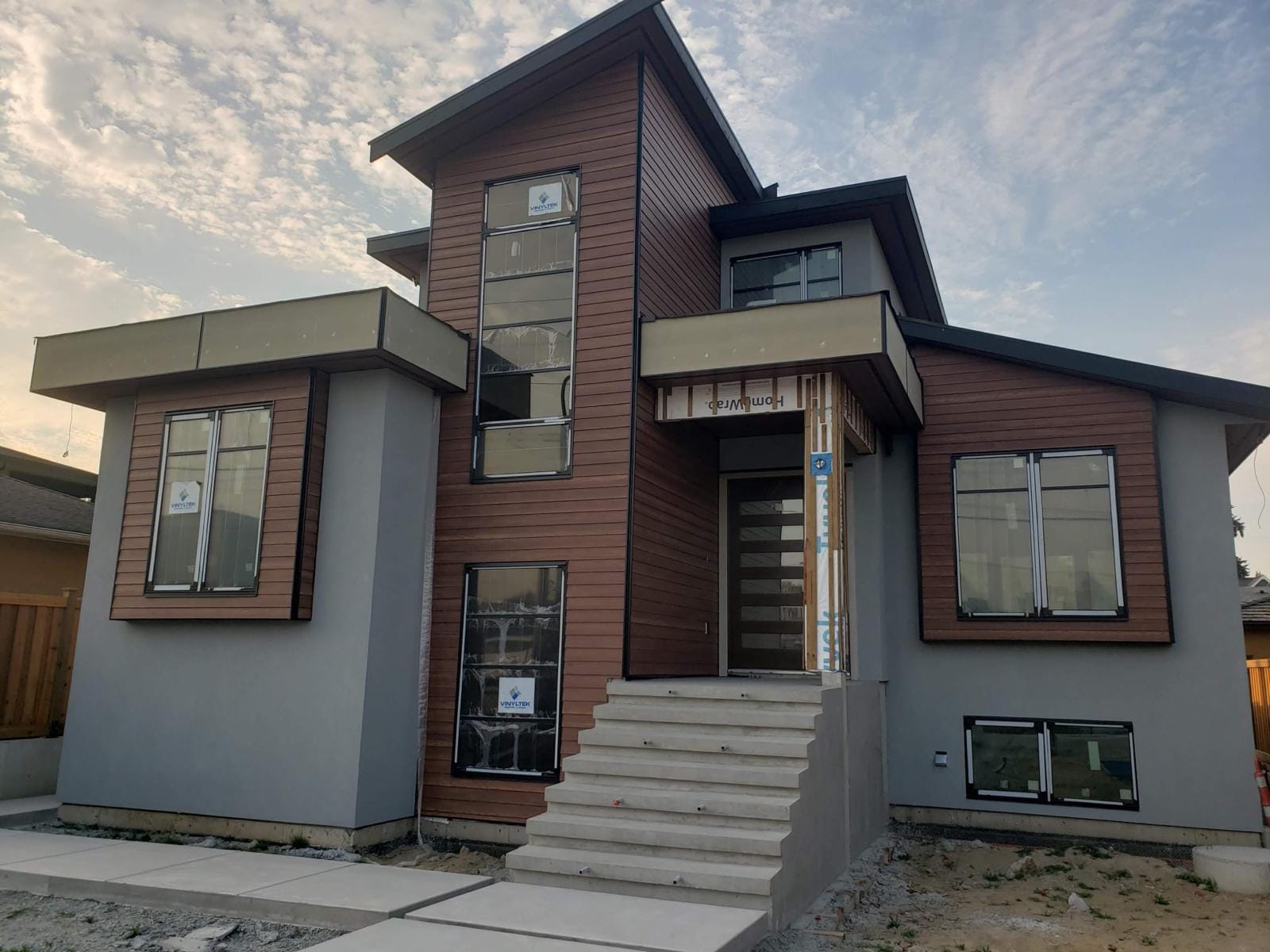
Siding Replacement in Surrey
Siding replacement across Surrey, where thousands of 1980s and 1990s homes are hitting the end of their original vinyl at the same time. Tear-off, wall repair and a new exterior, managed start to finish.
Built for how Surrey weathers.
Surrey is in a replacement wave. Original builder-grade vinyl from Fleetwood, Guildford and Newton has spent thirty to forty years in sun and storms, and no repair brings back cladding that has gone chalky and brittle across every wall. Because these are big houses, replacement here is also the moment insulation upgrades pay off: continuous exterior insulation added during recladding cuts heat loss through the whole wall. We run Surrey replacements on a fixed schedule with daily cleanup, because families live in these homes throughout the work.
Surrey mixes large 1980s and 1990s family homes in Fleetwood and Guildford, many with original vinyl now brittle and faded, alongside newer Clayton and Grandview Heights builds.
Replacing siding is the one chance to fix everything behind it: rot, missing barrier, bad flashing, no ventilation gap. We tear off to sheathing, repair what we find, rebuild the moisture layers to current standards and install the new cladding you choose.
- Complete tear-off to sheathing
- Rot and substrate repairs included in scope
- New weather barrier and rainscreen
- Upgrade material or match existing
- Insulation upgrade option during re-clad
- Disposal and recycling of old cladding
How we run siding replacement in Surrey.
Assessment and options
We inspect the existing walls and quote replacement options in two or three materials so you can compare.
Tear-off
Old cladding removed and disposed of. Sheathing inspected and moisture checked.
Repairs and barrier
Rot repaired, new weather barrier and rainscreen strapping installed.
New siding
Your chosen system installed to spec with new flashing and trim throughout.
Final walkthrough
Cleanup, magnet sweep for fasteners, walkthrough and warranty package.
Siding Replacement in Surrey: what owners should know.
An Entire City Reaching End of Life Together
Surrey has a timing problem no other Lower Mainland city shares at this scale. A vast number of houses went up through the 1980s and 1990s with the same builder-grade vinyl, which means a vast number of exteriors are finishing their service life simultaneously.
The signs are consistent: chalky faded colour that no longer washes clean, panels gone brittle enough to crack from minor impact, and matching for repairs getting harder every year as profiles go out of production. Once a wall reaches that stage, repairs are a holding action and each one is more visible than the last.
That is what brings most Surrey owners to replacement. But the reason replacement is worth doing well has less to do with the vinyl and more to do with what is behind it.
Two Things Make Surrey Replacements Different
Wall area. These are big houses. Large two-storey homes through Fleetwood, Guildford, Newton and Fraser Heights carry substantially more wall area than a compact city lot, which makes material choice a much bigger cost lever here than anywhere else we work. A per-square-foot difference that is trivial on a small bungalow becomes a significant number on a Surrey family home.
This is why we quote two or three materials side by side on nearly every Surrey project rather than assuming a preference. The right answer genuinely depends on your budget and how long you intend to hold the house, and you should see those numbers on your actual measured wall area.
Exposure. Open terrain through Cloverdale, Panorama Ridge and Fraser Heights means real wind loading. Wind-driven rain pushes water uphill into laps and joints, and wind lifts cladding mechanically. Exposed Surrey elevations get tighter fastener spacing, upgraded trim attachment and flashing detailed on the assumption water arrives horizontally.
What Is Behind the Old Vinyl
Most Surrey houses of this vintage were built face-sealed: cladding over building paper directly against sheathing, no drainage gap, no ventilation. The wall was expected to keep water out at the surface, with no plan for what happens when it eventually gets in.
Tearing off routinely reveals damp or stained sheathing, black staining where water has tracked down studs, rot below windows and at wall bases, and damage radiating from deck ledgers that were never properly flashed. Houses with no history of visible leaks frequently have all of it.
Replacement is the one occasion to correct it, and the correction is what determines whether the new wall lasts.
The Process
Assessment and written scope. Every elevation inspected, line-itemed quote in writing at no charge. Where we suspect hidden damage we say so up front, along with how we will handle it if we are right.
Tear-off to sheathing. Everything comes off. We do not clad over existing siding, which traps whatever moisture problem exists and hides the evidence you are paying us to find.
Substrate repair. Rotted sheathing replaced, damaged framing repaired, photographed as we go. This is the part that cannot be quoted precisely in advance, and we price it transparently rather than padding the base number.
Weather-resistive barrier and flashing. New barrier properly lapped and integrated with flashing at every window, door and penetration. Kick-out flashings at roof-to-wall intersections. Deck ledgers flashed correctly, since that is a recurring weak point on houses of this era.
Rainscreen strapping. A drained, ventilated cavity behind the cladding. The fundamental upgrade over the original face-sealed assembly.
Cladding, trim and roofline. New siding, trim, and usually new soffit and fascia while the staging is up.
Documentation and walkthrough. Photographs of everything behind the wall before it was covered, and a walkthrough together before final payment.
Exterior Insulation Pays Off Here
Surrey's 1980s and 1990s stock has minimal wall insulation by current standards, with thermal bridging through every stud, plate and header. Because these are large houses, that adds up to real heat loss across a lot of wall area.
Continuous exterior insulation installed outboard of the sheathing addresses the entire wall surface including the framing, which cavity insulation cannot do. The material cost is real but the labour is largely already committed: the wall is open, the crew is on site, the staging is up. Adding it later means removing new cladding.
On Surrey's large wall areas the comfort and energy difference is more noticeable than on a smaller house, which is why we price it as a clearly separated option on most quotes here.
Choosing Materials
James Hardie fiber cement is the most common upgrade. It resists the UV and impact damage that ended the original vinyl, its weight and rigidity suit wind-exposed elevations, it is non-combustible, and ColorPlus factory finishes remove painting from the schedule permanently. On a house you intend to keep, it is generally the better long-run value.
Engineered wood gives a warmer face at mid-range cost and is popular through South Surrey.
Premium vinyl remains legitimate for rental properties and budget-constrained projects, and modern lines are considerably better than the product they replace. We will install it without argument where it is the right fit, provided the assembly behind it is done properly, because the cheapest cladding does not justify skipping the barrier and flashing.
On commercial buildings and contemporary homes near City Centre we install AL13 and Lux steel panel systems and the EasyTrim Quick Panel system.
Living Through It
Most single-family Surrey replacements run one to three weeks depending on size, material, access and what we find. You get a schedule in writing before we start.
You can stay in the house throughout. Walls are never left open overnight without protection, we clean the site daily, and we finish with a magnet sweep for fasteners before the final walkthrough.
Stratas and Permits
Clayton and Sullivan's 2000s townhome inventory is reaching the age where envelope assessments start. For stratas we provide written scopes, phasing plans and photo documentation councils can circulate to owners and reference in depreciation report discussions, and we phase work so residents keep access and parking.
Like-for-like recladding on a single-family house generally does not require a building permit, while structural repairs, assembly changes and multi-family work often do. We confirm what your specific project requires with the City of Surrey during quoting and handle the application when one applies.
Siding Replacement questions in Surrey.
Siding Replacement quotes in Surrey.
Tell us about your Surrey project and we will respond within one business day to book a free site visit, then follow up with a clear, line-itemed quote.