
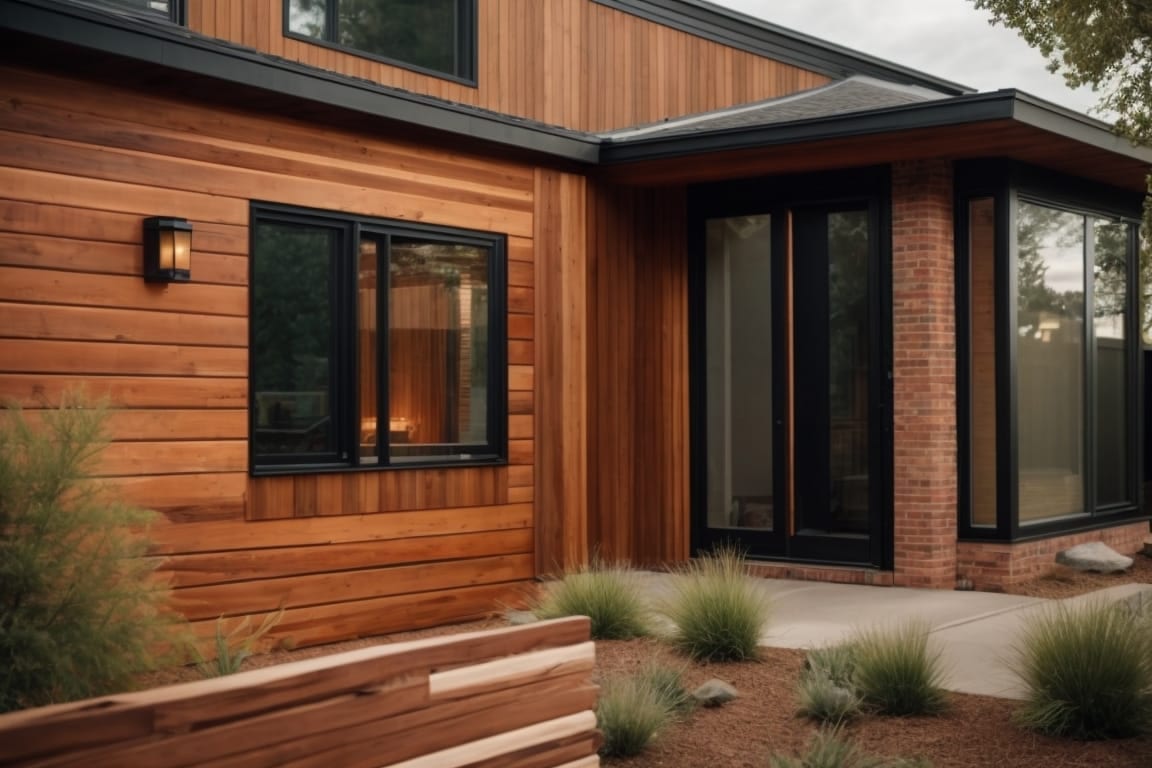
Cedar Siding in North Vancouver
Cedar siding for North Vancouver: repair, restoration and new installation of the North Shore's signature cladding, detailed for shade, moss and mountain rain.
Built for how North Vancouver weathers.
Cedar belongs on the North Shore, and it can thrive here: the failures we see in Lynn Valley and Deep Cove are almost never the wood's fault, but the detailing's. Boards nailed tight to sheathing with no gap, unsealed cuts, finishes stretched years past their life under tree cover. Our cedar work fixes the system: ventilated rainscreen, back-primed and end-sealed boards, stainless fasteners and a finish schedule matched to your lot's shade. That is how a cedar wall earns its decades in this rainfall.
North Vancouver homes in Lynn Valley, Deep Cove and along the mountain slopes sit on forested lots where cedar siding has been the default cladding for decades.
Nothing matches real cedar for warmth and West Coast character, and no material punishes poor installation faster in our climate. We install Western Red Cedar bevel, channel and shingle profiles over a ventilated rainscreen with stainless fasteners and proper finishing, which is what separates cedar that silvers gracefully from cedar that rots.
- Western Red Cedar, clear and knotty grades
- Bevel, channel and board-and-batten
- Cedar shingle and shake sidewall
- Rainscreen and stainless fastening
- Stain, oil or natural weathering options
- Repairs and partial replacement
How we run cedar siding in North Vancouver.
Grade and profile
Clear or knotty, bevel or channel, finish colour: chosen with samples against your home.
Rainscreen prep
Ventilated strapping and barrier so the wood can dry from both faces.
Install and finish
Stainless fasteners, sealed cuts and your chosen finish applied on schedule.
Cedar Siding in North Vancouver: what owners should know.
Why North Shore Cedar Fails, and Why It Usually Is Not the Cedar
Western Red Cedar has clad North Vancouver homes for a century. It is naturally rot-resistant, it handles the coastal climate better than most softwoods, and nothing else quite matches it against a forested lot. So when a Lynn Valley or Deep Cove wall is grey, soft and streaked after thirty years, the wood is rarely the thing that failed.
Almost every failed cedar wall we open up on the North Shore shows the same set of installation shortcuts, and each one is fixable on the next go.
No ventilation gap. Cedar installed before rainscreen construction became standard practice was typically nailed straight to the sheathing over building paper. The back face of every board sat against a damp surface with no air movement and no way to dry. Cedar can shed water from the front indefinitely. It cannot survive being permanently wet from behind.
Unsealed cut ends. End grain absorbs water many times faster than face grain. Every board cut on site and installed without sealing the fresh end created a wick, which is exactly why rot so often starts at butt joints and around window and door trim rather than in the middle of a board.
Finish stretched too long. Under Blueridge and Lynn Valley tree canopy, finishes degrade faster and walls stay damp longer. A finish schedule that would be fine in Kelowna leaves North Shore cedar unprotected for years at a stretch.
The wrong fasteners. Non-stainless fasteners react with the natural tannins in cedar. The black streaking below nail heads on older North Vancouver walls is that reaction, and corroding fasteners eventually loosen their grip on the boards as well.
Tight clearances. Cedar held too close to grade, decks or roof surfaces stays in contact with standing water and splash. Those are the first boards to go soft, every time.
Repair or Replace: How We Decide
We price the repair first whenever the wall can carry one, because on a wall with sound material it is a fraction of the cost of recladding and it is the honest answer.
The assessment is physical, not visual. Weathered grey cedar is often perfectly sound underneath, since silvering is a surface effect and says very little about the structural condition of the board. We probe the areas that actually predict failure: board butts, the bottom two or three courses, around every window and door, at deck ledgers and roof intersections, and anywhere staining suggests water has been tracking. We check moisture levels on shaded elevations, and we look at the back of boards where access allows.
Repair makes sense when the failures are localized, the majority of boards are sound, the sheathing behind is dry, and the cause is something we can correct: a flashing detail, a clearance problem, a gutter that has been overflowing.
Replacement makes sense when soft wood is widespread rather than clustered, when multiple elevations are failing at once, when the sheathing behind shows moisture damage, or when the wall was built with no drainage path and you are facing the same failure again in a decade regardless of how well we patch it.
When it is genuinely a close call, we show you the evidence with photographs and price both paths so the decision is yours on real numbers rather than on a contractor's preference.
What a Proper Cedar Repair Includes
A cedar repair that lasts is not just new boards. We source matching profile and grade, back-prime and end-seal every replacement board so all six sides are protected, fasten with stainless, and correct whatever detail let the water in. If the cause was a missing kick-out flashing, the repair includes the flashing. If it was grade clearance, we address the clearance.
We then set a realistic refinishing schedule for your specific elevations. On the North Shore that generally means roughly three to seven years depending on exposure, with heavily shaded walls at the short end and protected south-facing walls at the long end. Refinishing on schedule is the single highest-return maintenance action a cedar owner can take here.
Restoring Weathered Cedar
Where boards are sound but tired, restoration brings a wall back for far less than replacement. That work involves cleaning the surface to remove moss, algae and degraded finish, replacing individual failed boards, treating any surface mould, and refinishing with a system suited to the exposure. On shaded North Vancouver elevations we favour finishes with real UV and mildew resistance, and we are candid that a semi-transparent finish on a heavily shaded wall will need attention sooner than a solid one.
New Cedar Installed for This Climate
When cedar is going back on, it goes on over a ventilated rainscreen: strapping that creates a drainage and drying cavity behind the cladding, a properly detailed weather-resistive barrier behind that, and flashing at every window, door, deck and roof intersection. Boards are back-primed and end-sealed before installation, fastened with stainless, and held at generous clearances from grade, decks and roofs.
That assembly is the difference between cedar that silvers gracefully for decades on a North Shore lot and cedar that becomes a recladding project in twelve years. It costs more than nailing boards to a wall. It costs dramatically less than doing this twice.
Cedar Versus the Alternatives on the North Shore
Some owners love cedar and accept the maintenance. Others love the look but not the schedule. Both are reasonable, and we quote both.
James Hardie fiber cement offers wood-grain profiles with a similar shadow line, does not rot, does not feed moss and holds a factory finish through shade and rain cycles that fade field-applied products early. On heavily shaded Lynn Valley and Blueridge elevations it is the most common recommendation we make. Engineered wood sits between the two on both warmth and upkeep.
If you want the cedar look permanently maintenance-free, Longboard woodgrain aluminum reproduces it in a material that is entirely indifferent to North Shore weather.
We bring samples of each to the site visit, because judging a finish under North Shore light is very different from judging it in a showroom.
Cedar Siding questions in North Vancouver.
Cedar Siding quotes in North Vancouver.
Tell us about your North Vancouver project and we will respond within one business day to book a free site visit, then follow up with a clear, line-itemed quote.