
Soffit Ventilation and Attic Moisture: The Hidden Connection
How soffit ventilation controls attic moisture in BC homes, the warning signs when airflow is blocked, and why the fix often starts at the roof overhang.
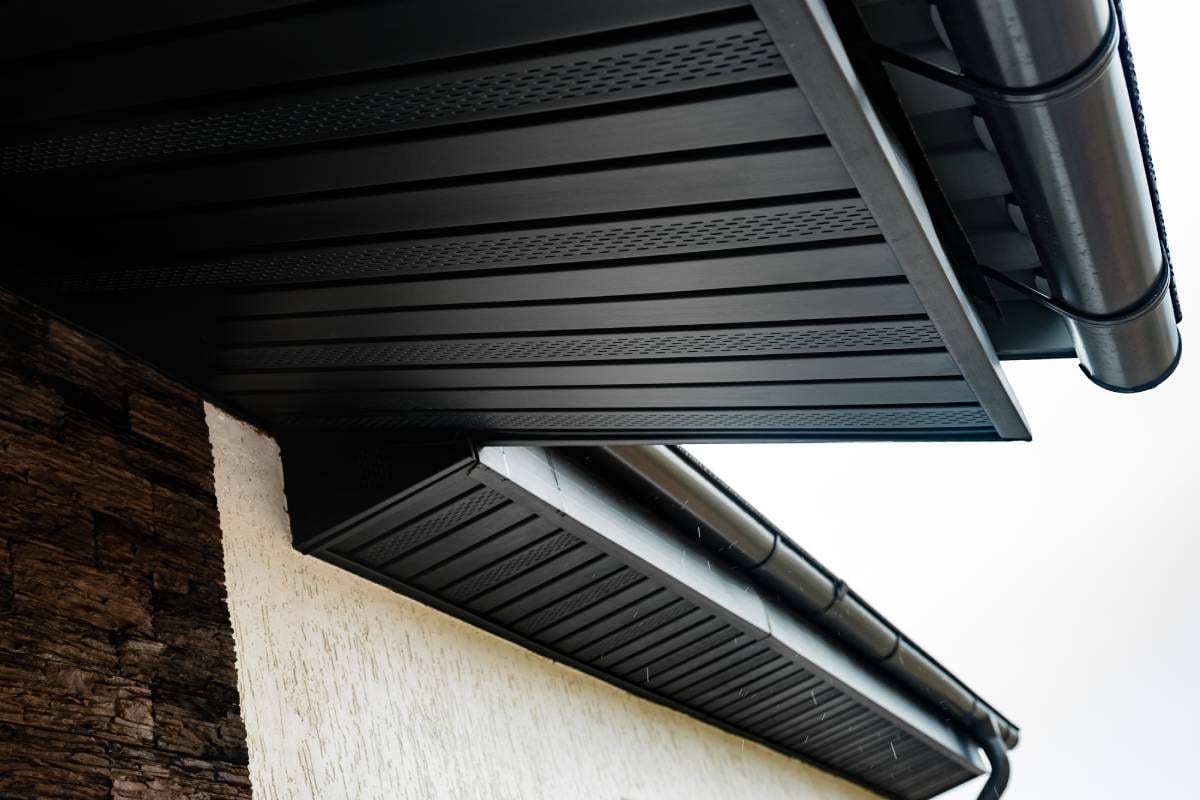
If you have frost on your attic sheathing in January, staining on the underside of the roof, or a musty smell upstairs, the cause is often not the roof at all. It is usually the soffits, the perforated panels under your roof overhang, failing to move air. Soffit ventilation is the intake half of the attic's breathing system, and when it is blocked, moisture that would normally be carried away settles into the coldest wood in the house.
How an Attic Is Supposed to Breathe
A healthy attic runs a continuous, slow air exchange. Cool outside air enters low through perforated or vented soffit panels at the eaves, warms slightly, picks up whatever moisture has migrated up from the living space, and exits high through ridge, roof or gable vents. Intake low, exhaust high, driven by simple convection.
Both halves must work. Exhaust vents without soffit intake have nothing to pull from, so air movement stalls. And in our climate, stalled attic air is loaded air: through a Lower Mainland winter, indoor humidity constantly migrates upward through ceiling penetrations, pot lights, attic hatches and wall tops. The ventilation stream is what carries that vapour out before it becomes water.
Where the Moisture Actually Comes From
Attic moisture is mostly homemade. Cooking, showers, laundry, plants and people generate vapour all day, and warm humid air rises. Every gap in the ceiling plane is a channel upward. Add a bathroom fan ducted into the attic instead of through the roof or wall, a surprisingly common find, and the attic receives a direct humidity feed several times a day.
In a ventilated attic, this loading is manageable: the airstream dilutes it and carries it out. In a starved attic, the vapour meets the underside of roof sheathing that sits near outdoor temperature, and physics does the rest. Condensation forms, frost builds during cold snaps, and every thaw releases the accumulation into the wood and insulation below.
What Chronic Attic Moisture Does
The damage sequence is slow enough to hide and steady enough to matter:
- Sheathing decay. Repeated wetting darkens, delaminates and eventually rots plywood and OSB from the inside, shortening roof life invisibly.
- Mould colonization. Damp wood and still air are exactly what mould wants, and attic mould can pressure indoor air quality through the same ceiling gaps the moisture used.
- Flattened insulation. Damp insulation loses loft and performance, cooling the ceiling, which increases condensation risk in a feedback loop.
- Ice damming. A poorly ventilated attic runs warm, melting roof snow that refreezes at the cold eaves during our occasional cold snaps, backing water up under the roofing.
Left long enough, this stops being a ventilation project and becomes a restoration project, with sheathing replacement and mould remediation on the list.
Why Soffits Are Usually the Weak Link
When we trace attic moisture problems backward, the intake side fails far more often than the exhaust side, for mundane reasons:
- Insulation added without baffles. Extra insulation is good for the house, but blown-in material drifts into the eaves and plugs the intake path unless baffles hold the channel open. Many well-intentioned insulation upgrades quietly suffocate the attic.
- Paint and grime. On older homes, layers of paint and decades of dirt can seal perforated aluminum soffits almost completely.
- Undersized or fake venting. Some homes were built with minimal perforation, or with solid panels where vented ones belong.
- Nests and debris. Birds, wasps and rodents find eaves attractive, and their nests block airflow precisely where it matters.
A related failure comes from next door in the assembly: rotting fascia or chronically overflowing gutters can soak soffit panels and the framing behind them, adding moisture at the intake instead of dry air.
Diagnosing Your Own Attic
A homeowner can gather most of the evidence safely. On a cold morning, look at the attic from the hatch with a good light: check the sheathing for frost, droplets or staining, look at nail tips for rust, and note whether you can see daylight or baffle channels at the eaves. Outside, walk the overhangs and confirm the soffit panels are actually perforated or vented, not solid or painted shut. Then confirm every bathroom and kitchen fan ducts to the exterior, not into the attic. If the sheathing already shows widespread staining or the eaves are packed solid with insulation, bring in a professional before the next winter loads the attic again.
Balance, Not Just More Holes
Ventilation is a ratio, not a quantity. Building practice pairs intake area at the eaves with exhaust area near the ridge, and the system works when the two roughly balance, with intake matching or slightly exceeding exhaust. This is why piecemeal fixes disappoint: adding gable vents to an attic with plugged soffits changes the airflow pattern without solving the starvation, and can short-circuit the path so air skips the eave areas that need washing most. Before adding any vent, establish what intake and exhaust the roof already has, then correct the weaker side first.
Fixing the Intake
The remedy matches the cause: clearing or replacing blocked panels, installing baffles to reopen eave channels, upsizing intake area on under-vented homes, and correcting any exhaust fans dumping into the space. Soffit renewal pairs naturally with siding and roofline work, since access equipment and trades overlap, and new soffits transform the look of the overhangs at the same time as they restore airflow.
Berkana Construction Management installs and renews soffits across Maple Ridge and the Lower Mainland as part of complete exterior work. If your attic shows the signs, call (672) 771-6868 or arrange an assessment before another wet season settles in.